The Path to Liberation

Liberation: Introduction
Before we begin, it's important to first see the Gradual Training from the right perspective.
-
We’ll first begin by a brief explanation of the Gradual Training.
-
We’ll then consider common misunderstandings that have shaped, and can distort our understanding of the training.
-
We’ll see why it is important to return to the suttas and not rely solely on interpretations, not merely to read their words, but to penetrate their meaning and put the teachings into practice.
-
Finally, we’ll consider what is needed to read, contemplate, and apply the teachings in the suttas faithfully.
Having this foundation in place will help us approach the Gradual Training with greater clarity and allow us to put it into practice with clearer understanding.
Liberation: The Gradual Training
In brief, the Gradual Training is the practice of letting go of craving, aversion, and delusion.
These three forces lie behind the suffering we experience: craving, which reaches for the pleasant and clings once it has it; aversion, which pushes away the unpleasant whether present or merely feared; and delusion, which misreads both, taking the impermanent for lasting and the not-self for "mine." Left unknown, they shape our actions, speech, and thoughts and keep us circling in dissatisfaction.
The training is called gradual because it moves in stages. Nothing is being accumulated along the way, each stage releases a coarser layer of craving, aversion and delusion, and the settling that follows is what allows a subtler layer to be addressed.
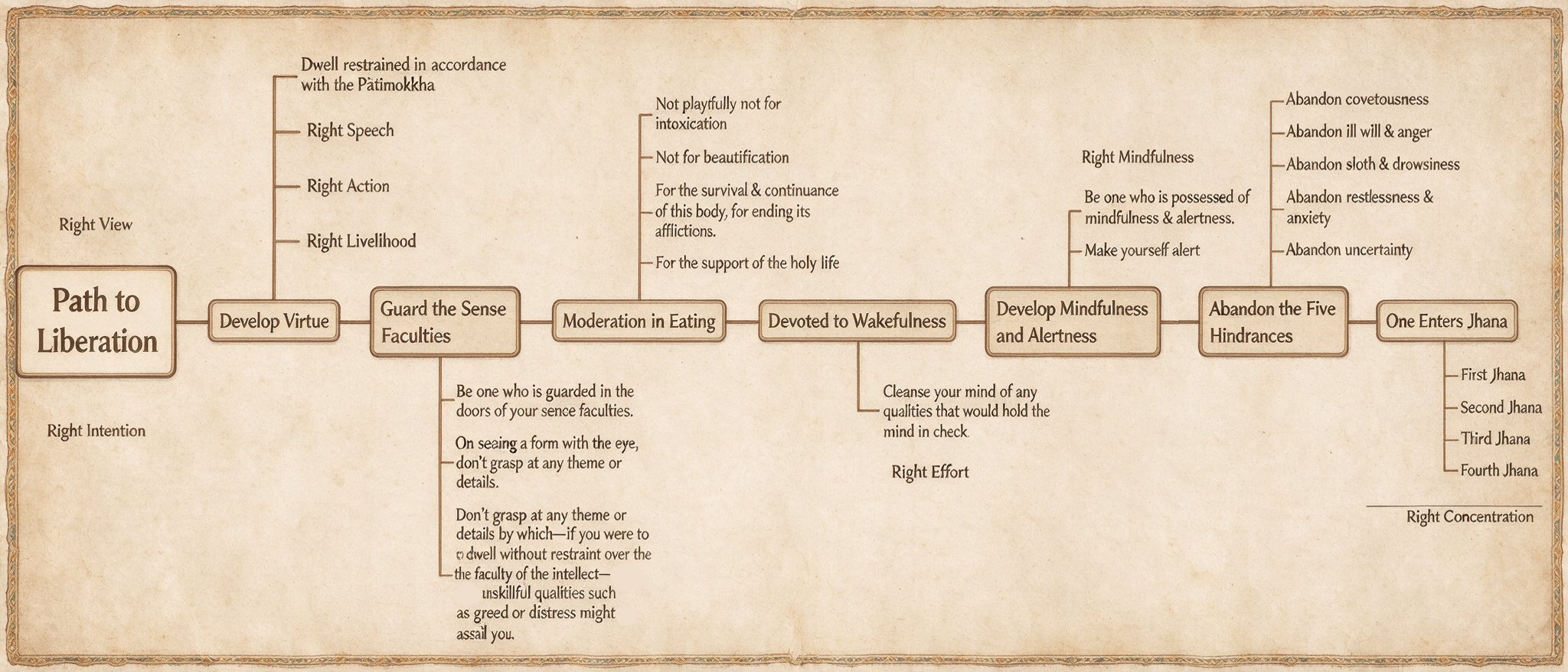
Right View is always the priority of the path, it is what everything else depends on. But until it is established, we can begin the practice of Sīla, guarding the sense doors, and the practice of wakefulness, all of which quiet the mind enough for Right View to arise.
-
Sīla (purification of mental conduct) restrains unwholesome bodily, mental and verbal actions. By reducing harm and the remorse that follows it, it gives the mind a steadier foundation.
-
Guarding the sense doors means meeting sights, sounds, and other experiences without getting entangled in them. This keeps us from feeding greed, aversion, and delusion.
-
The practice of wakefulness cultivates diligence and alertness. It helps us notice when the mind is growing heedless or caught in unwholesome thoughts, and return to what is skillful.
-
Right mindfulness develops clear, sustained awareness of the body, feelings, mind, and patterns of experience. Abiding closer to the source, we can see how affliction arises, develops, and ceases.
Abandoning the five hindrances accomplished by developing the Seven Factors of Awakening, each of which counteracts a particular hindrance.
- Developing the jhānas deepens concentration and steadies attention, providing a strong basis for seeing experience clearly.
Ultimately, liberation from suffering comes when all eight factors of the path work together in harmony.
These practices are not competing routes. They work together, each preparing the ground for the next, until the grip of craving, aversion, and delusion loosens and the mind is released from suffering.
Liberation: Is There a Quick Path?
Liberation is often imagined as the reward of a long wait, arriving in a single extraordinary experience; or as a sudden state that will one day erase every affliction at once. Both views depict liberation as something other than the teaching describe.
Let's examine these misunderstandings, what the training actually asks of us, and what can begin to change right now.
Liberation is a distant or sudden attainment
It is easy to imagine liberation as something that happens only at the end of the path, a special state that arrives and erases every affliction at once. But the Gradual Training is not a wait for such an experience. It is practical work: Purifying mental conduct, guarding the sense doors, the practice of wakefulness, right mindfulness, abandoning the five hindrances, and the jhānas developed from the first through the fourth.
The path is gradual in its development, but its benefits are not postponed to the end. The practice steadily reduces our entanglement with, and dependence on, what causes suffering, and that shows up as a more peaceful mind here and now. The path is therefore neither a shortcut nor a long delay. It is a way of working with suffering that can begin immediately.
Nibbāna is a thing that destroys affliction
Nibbāna, commonly known by its Sanskrit form, Nirvana, is sometimes imagined as a special object or state that will arrive and eliminate suffering, bringing complete and unbroken happiness. But nibbāna means the cessation of craving, aversion, and delusion. It is not a separate attainment that removes them from outside.
The distinction matters. If liberation is an extraordinary experience to be acquired, then the practical training can seem secondary: merely a means to an end, while the end itself does all the real work. If liberation is the ending of defilements, then abandoning them and preventing them from arising is not preparation for liberation. It is the path itself.
For example, health is the absence of illness, not a separate thing that arrives to destroy illness. In the same way, nibbāna is the cessation of defilements, not something that eliminates them.
A promised experience will end suffering
People have encountered teachings that promise a sudden realization, described with words such as extinction, cessation, Nirvana, awakening, or enlightenment, that will quickly bring happiness and end suffering. Such promises create wrong expectations and distort understanding of the training.
The suttas do describe awakening after a single discourse, but those listeners were already prepared by practice, the teaching met a ready mind, it did not replace the path.
Rather than relying on claims about a sudden attainment, we need to examine what the suttas actually teach. Across many discourses, the training concerns the ending of craving, aversion, and delusion, and the practices that bring it about. This is why right view matters: we need to study the suttas to understand what the Tathāgata (the Buddha) taught about liberation and the path leading to it, in particular, how the teachings address craving, aversion, and delusion in relation to form, feeling, perception, volitional formations, and consciousness. Understanding the aim of the Gradual Training keeps the practices from being reduced to techniques for chasing experiences.
Awakening is annihilation or blankness
Because the training speaks of cessation, it can sound as though the goal is to become nothing, or to stop experiencing altogether. But nothing is being destroyed: what ceases is craving, aversion, and delusion, the activity that produces affliction, not experience itself.
Awakening is a permanent blissful feeling
A related misconception is that liberation will feel endlessly pleasant. But in truth, an awakened person is still subject to pain, illness, and the body's decline. What changes is that these are no longer met with craving and aversion. Peace here means the absence of affliction, not a continuous pleasant sensation. This is why even the refined bliss of the jhānas is not liberation.
Liberation can be given, or must wait for ideal conditions
Some teachings promise that awakening can be transmitted by a teacher, an initiation, or a secret method. Others imply that it requires perfect circumstances first: the right retreat, the right teacher, a monastic life.
The Tathāgata described his teaching as given with an open hand, holding nothing back. So the obstacle is never a withheld teaching. It is dust in the eyes: he spoke of beings with little dust and beings with much, and where the dust is thick, the world is what blinds. To be reading this at all means there is the possibility that the dust is not too much, and that the conditions may be present to develop the path through one's own understanding and effort, beginning with whatever is here now.

The Tathāgata's Teachings
After obtaining enlightenment, the Tathāgata (Buddha) initially hesitated to teach because his insights were too profound and subtle to grasp. He believed the teaching he had realized was too profound and subtle to grasp, and that beings preoccupied with worldly pleasures and attachments would be unlikely to accept it.
The Tathāgata’s reluctance to teach was overcome when Brahma Sahampati urged him to share his teachings, assuring him that there were individuals with little dust in their eyes, ready to comprehend and benefit from his teachings. Consequently, the Tathāgata began teaching, delivering his first sermon at the Deer Park in Sarnath, which marked the start of his extensive teaching career spanning 45 years.
So, it's important to remember that the Tathāgata's supermundane teachings were never meant for the average person, who was preoccupied with worldly pleasures and attachments. They were meant only for those few people with "little dust in their eyes" who were willing to renounce, seek the truth, and make the considerable effort needed to achieve liberation from "the world."
SN56.31: The Blessed One, while in the Sīsapā forest near Kosambi, used sīsapā leaves to illustrate a point to the disciples. He compared the few leaves in his hand to the vast number in the forest, explaining that what he has taught them is only a small fraction of what he knows. However, he chose to teach only what leads to enlightenment and Nibbāna, focusing on the nature of suffering, its origin, cessation, and the path leading to its cessation. This teaching is essential for achieving the holy life and ultimate peace.
Penetrating the Suttas
To truly understand and penetrate the Tathāgata’s teachings, we must read the discourses for ourselves, rather than relying on hearsay or others’ interpretations. Genuine understanding arises when we have read, reflected upon, and repeatedly contemplated the teachings, putting them into practice until their meaning becomes clear through direct experience.
However, one must keep in mind that the Tathāgata's teachings were intended for people with a very different mindset who lived around twenty-five hundred years ago. We now live in a world where people are overwhelmed with information, have very short attention spans, where words have lost their meaning, and very few people are willing to figure things out for themselves.
This means that we need to change our expectations about how teachings should be delivered, not as step-by-step instructions to follow but as pointers in the direction to explore and discover the truth that lies inside for ourselves.
It's also important to understand that the Tathāgata teaches only about suffering and the cessation of suffering. His teachings are not about physical reality, how things "should be," or some ultimate "true reality" in a philosophical sense. Instead, they address mental experience and how we can train the mind to let go of suffering.
The Gradual Training Requires Direct Experience
It is important not to fall into the trap of collecting more and more information, thinking that conceptual knowledge will help us advance in the practice or will lead to liberation. Nor is the path something we can design by selecting a few teachings that feel useful at the moment. The teachings are structured so that, when followed in the proper sequence, each stage trains the mind through direct experience. The teachings gradually shift how the mind operates, moving it away from the habits that create suffering and toward relinquishment that leads to release.
The training depends on the mind clearly seeing causes and conditions, seeing which patterns lead toward freedom and which lead toward more entanglement. It is not a matter of memorizing ideas, it is a matter of developing the mind so that it naturally lets go from having seen the truth, instead of creating more stress based on ignorance. Because of this, the teachings can only be known through practice. Conceptual understanding alone will never reveal what the Tathāgata was pointing to. Only the development of Right View makes the meaning clear.
Read the following Sutta to understand the Tathāgata's Gradual Training and why each part of the path is dependent on a certain level of mastery of previous stages to proceed.
Read another Sutta that covers the progression of the path from a different angle:
How to Read Suttas
It's important to remember that the Tathāgata adapted his teachings to various audiences with different mindsets and diverse situations.
What we have now in the form of Suttas was written down many centuries after the Tathāgata's passing away. Before then, the Suttas were formatted in such a way, with a lot of repetition, so that they could easily be memorized for chanting, which is how they were passed on for hundreds of years before they were written down. The format was not meant for modern-style reading, but to be chanted and remembered easily.
Many Suttas were meant as guided meditations, and were not meant to be read, or listened to for detailed instructions.
It's also important to understand that the mindset back then differs greatly from today, so we should be cautious not to consider English translations as the exact words of the Tathāgata. Many words in the Pali language don't have English equivalents, and some concepts and ways of thinking are radically different and are no longer present in the modern world.
The Tathāgata's teachings are primarily about freeing the mind from its tainted perceptions of the world; it's important not to confuse his teachings as being about the physical world itself.
Further points to keep in mind about the Suttas:
-
As a result of his 45 years of discourses, 84,000 discourses were delivered, each as a doorway to liberation, tailored to the different needs of people and audiences that he encountered. However, this doesn't mean you should read all 84,000 suttas or that you will understand them right away. Read suttas pertinent to your practice at the time by trying to understand the overall meaning, then practice finding the truth for yourself. Then, read them again to validate your practice.
-
It's important not to cling to or attempt to understand the exact meaning of words, as words cannot truly convey the deep concepts of Dharma. Instead, try to understand the big picture being created, view Suttas as a guide, and discover their meaning through practice.
Many words in the suttas, when translated into English, are given a static meaning. For instance, "right" can be interpreted as static right or wrong, but the correct meaning of most words used in the discourses should be understood as actions, movements, cause, and effect. After all they are meant to effect change. Therefore, "Right Speech" should be seen as a constant process, for example, the continual developing the mind to avoid causing harm to oneself and others through thought and speech.
- Words like suffering have extreme connotations in the modern world; however, in ancient times, suffering had a much broader meaning and could also mean mild discomfort.
-
The Suttas are full of similes. In the same way that a picture is worth a thousand words, the Tathāgata uses similes and stories to convey meaning in a way that is more accurate than words alone can achieve. So don't dismiss them as not relevant to modern times or just simple stories; they are powerful instructions on how to practice and develop Right View. They aid in visualizing the mindset required to practice correctly.
-
Most Suttas target people at different levels of attainment, such as laypersons, stream-enterers, once-returners, non-returners, and arahants. If you find a sutta challenging to understand, it may be aimed at a more advanced level, and the conditions might not be present yet for you to comprehend it. In such cases, explore another Sutta for contemplation.
-
Many Suttas paint a picture of practice at the conventional level; however, often the message is also meant to be used at the very subtle level of practice. For example, clinging and aversion will also manifest as very subtle movements of the mind.
-
Sutta translations are far from perfect and may contain errors. There's no need to cling to exact wording; try to understand the overall message, which becomes evident as you read more Suttas.
The Teachings: Pointing the Way
Keep in mind that the reason the Tathāgata often didn't give precise instructions or didn't go into great detail regarding his teachings is because the only way to get insight is to develop it for yourself. Just listening to or reading Dhamma will generally not be enough, one must put the teachings into practice.
He only pointed the way how to get there. The rest has to be figured out by oneself through contemplation and practice.
View the Suttas as guides that need verification through practical experience rather than rigid adherence.
84,000 Doorways to Liberation
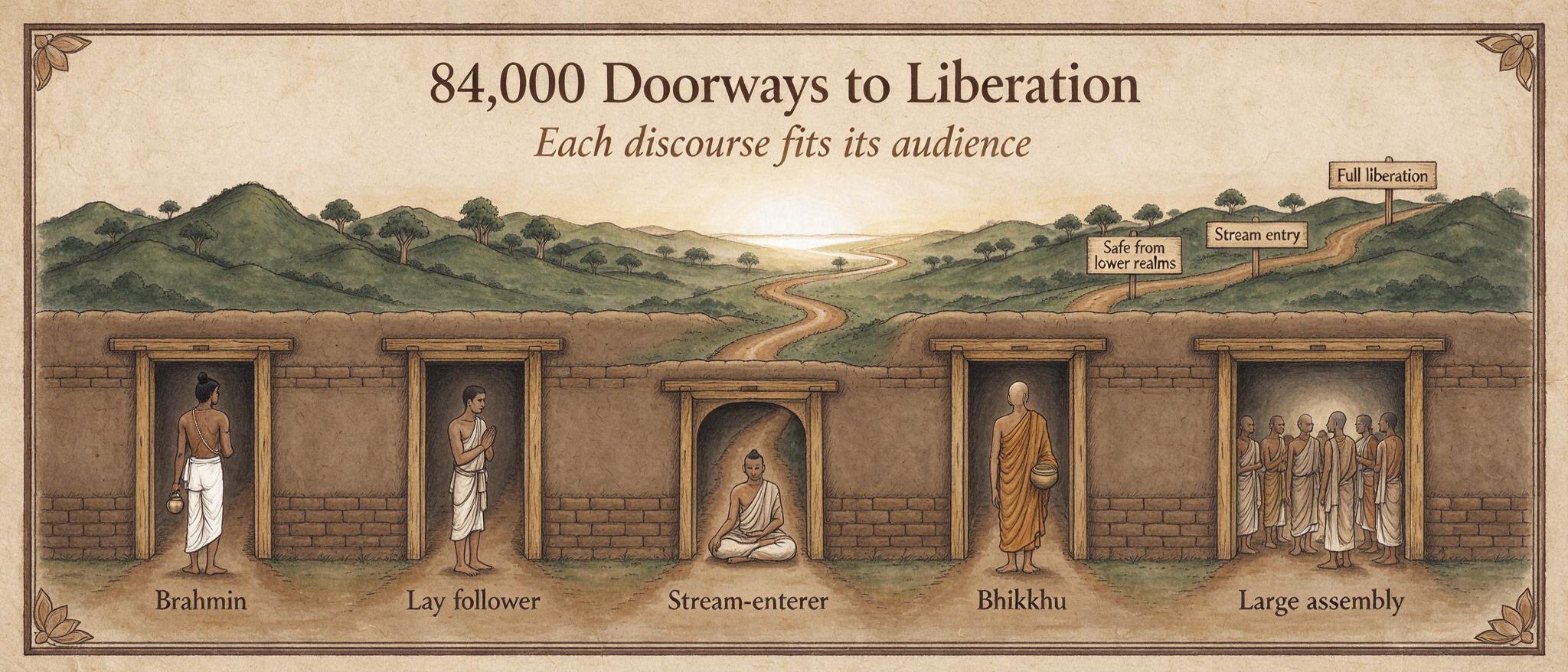
Each of the Tathāgata’s discourses can be understood as a doorway to liberation, carefully adapted to the people he addressed. As you read, consider who was listening and what they needed. Whether he was speaking to brahmins, lay followers, stream-enterers, or other disciples, he adapted his teaching to their needs, capacities, and circumstances.
Sometimes he taught one person; at other times, a large assembly. Yet most discourse had a clear purpose: to prevent someone from falling into lower realms, guide them toward stream entry, or lead them ultimately to full liberation. The teaching was not one-size-fits-all; it was suited to its purpose and its audience.
For this reason, approach each sutta with an understanding of its intended context. Not every teaching is meant to be applied universally. Some were directed to a particular person or group, just as a key is made to fit a particular lock.
As you study the suttas, ask yourself: Who was this teaching meant for, and why was it given? Each sutta is a doorway to liberation for a specific audience, and a teaching may not suit your level of practice or present circumstances. Keep this in mind as you read. Rather than applying every teaching in the same way, approach the suttas wisely and use them appropriately in your own practice.
Different Versions of the Gradual Training
Just as the Tathāgata adjusted what he said to suit his listeners, he also adjusted where he began, and how far he went.
For everyday laypeople, the focus was on simple, practical steps: living ethically, being generous, and taking care of life in wholesome ways. These create a stable foundation for the mind and ease unnecessary suffering. They also prepare the ground for something deeper: a mind steadied by generosity and good conduct is better able to hear the teaching of suffering and its ending, and many laypeople who heard it in that condition entered the stream.
For those already committed to a spiritual life, Brahmins, wanderers of other schools, and those who had left household life, he could begin further along. Where the ground was already prepared, he might move more quickly into renunciation, restraint, and the training of the mind. The order could shift to suit the listener, but the direction never did.
Training That Leads Beyond this World
There is also the training that leads all the way out, the supermundane training, aimed at full liberation. This is the one the rest of this training follows. It moves step by step through sīla, concentration, and insight, not as three separate exercises but as one training that matures: conduct that settles the mind, a settled mind that can see clearly, and clear seeing that releases the mind. Suttas such as the Satipatthana Sutta (MN 10), the Anapanasati Sutta (MN 118), and the Mahasatipatthana Sutta (DN 22) show how mindfulness and insight are developed in this way, carrying the disciple through the stages of stream-entry up to arahantship.
Whatever the audience, the training begins with Right View. Without Right View and Right Intention, the other factors lack direction; with them, the whole path turns toward liberation.
MN107: The Tathagata compares the training of an accountant with the step by step spiritual path of his followers. But even with such a well explained path, the Tathagata can only show the way, and it is up to us to walk it.

Just as a man seeking a water snake, searching for a water snake, wandering in search of a water snake, might see a large water snake. He would catch it by the body or the tail. That water snake would turn back and bite him on the hand, arm, or some other part of the body. Because of that, he would meet death or deadly suffering. What is the reason for this? Because of the wrong grasp of the water snake, disciples.
In the same way here some foolish people learn the teachings: the discourses, mixed prose and verse, explanations, verses, inspired utterances, sayings, birth stories, extraordinary teachings, and analyses. Having learned the teachings, they do not examine the meaning of those teachings with wisdom. For them, those teachings, not examined with wisdom, do not lead to deep understanding. They learn the teachings for the sake of fault-finding and for the sake of winning debates. They do not experience the purpose for which they learn the teachings. For them, those teachings, wrongly grasped, lead to long-term harm and suffering.
MN22