Right View - Understanding Suffering and its Cause

Right View: Introduction
In this section we will explore the First Noble Truth: the truth of suffering.
-
We will consider briefly why the Gradual Training begins with Right View.
-
We will examine what suffering means and the three types of suffering.
-
We will look closely at the Five Aggregates and see how they are conditioned and not self.
-
We will look at why the aggregates subject to clinging are described as suffering.
-
Finally, we will contemplate the different ways we cling to these aggregates
Penetrating the first noble truth of suffering, together with the fourth noble truth: the path to the cessation of suffering, which we will cover in the next section, puts us in the right frame of mind to give ourselves to the training wholeheartedly. We no longer practice to escape a vague unease, but with a clear sense of what the problem is and what actually resolves it.
The Gradual Training: Starts at Right View
To understand and penetrate the wisdom of the teachings, we must first understand and penetrate the first noble truth, the truth of suffering. This cannot be accomplished by reading and learning concepts alone. Teachings and concepts may point the way, but we must examine our own experience and see for ourselves how suffering arises.
To develop Right View, we must contemplate the Five Aggregates: form (the body and the material things we encounter), feelings, perceptions, mental formations, and consciousness. We must see that they are not “me, myself or mine.” Each depends on previously created conditions that are not under our control. The Five Aggregates cannot be depended on to provide lasting security. We must see this in our direct experience, not merely understand it as an idea.
Right View is crucial because it changes the mind’s orientation. Before Right View arises, the mind doesn't understand the problem and aims at the wrong goal. It seeks dependability, comfort, identity, or satisfaction in the very processes that produce stress. Without Right View, we apply effort without understanding what binds us. When Right View is established, the motivation to practice becomes natural. Intention becomes sincere and gains momentum.
With Right View, we follow the Eightfold Path not out of duty or belief, but because we understand our own predicament. The path no longer feels like a self-improvement project or a task imposed on top of suffering. It becomes a process of release.
Right View comes first in the Eightfold Path because it turns the mind toward freedom and makes the rest of the path genuinely achievable.
The Five Aggregates: Why Clinging Causes Suffering
In life, there is suffering: birth, aging, sickness, death, not getting what we desire, encountering what we dislike, separation from loved ones, in brief clinging to the Five Aggregates (form, feelings, perceptions, volitional formations, and consciousness). How can one truly understand clinging to the Five Aggregates? The seven sufferings can be felt, but it is challenging to recognize the suffering of clinging to the Five Aggregates, yet it is said to be the root of all suffering. What does that mean?
So, what are these Five Aggregates? In simple terms, they are the body, feelings, perceptions, volitional formations, and consciousness. These five phenomena constitute the Five Aggregates. But what are the Five Aggregates of clinging?
For an individual, the Five Aggregates of clinging are what one identifies as "me" or "mine." These include everything that people identify as themselves or as belonging to themselves. This encompasses the seven sufferings of birth, aging, sickness, death, not getting what we desire, encountering what we dislike, and separation from loved ones.
Why are the Five Aggregates Suffering?
You might wonder why these Five Aggregates, the body, feelings, perceptions, volitional formations, and consciousness, are considered suffering. After all, there are moments of happiness and even times when we don't experience unhappiness at all. For example, when you're with someone you love, all aspects of the body, feelings, thoughts, and consciousness are pleasant. Enjoying good food, beautiful scenery, fragrances, massages, music, movies, and more can bring happiness. Furthermore, many times, people find themselves in states of neither happiness nor unhappiness, right?
That's true. The Five Aggregates of clinging can bring happiness or unhappiness and even suffering, and there are times when they neither bring happiness nor unhappiness. However, if you think about it more deeply, you'll realize that all worldly happiness is impermanent.
There are three aspects to this impermanence:
First, all phenomena or things are not lasting. Nothing can exist forever. Regardless of how much you love something, it will eventually depart from you, or you'll depart from it. There is no eternal togetherness; there is no forever. The stronger the attachment when something exists, the greater the distress when it's lost.
Second, the Five Aggregates of clinging themselves are impermanent. They can't last forever. The body requires constant nourishment to stay in existence, and even with that, it will eventually disintegrate in a few decades. This is what people fear: death. Feelings, perceptions, volitional formations, and consciousness are even more fleeting; they disappear in an instant. We need continuous contact with objects to maintain feelings and consciousness. It takes abundant energy to keep our imaginations and thoughts active. All of this effort is stress or suffering, and it ultimately amounts to nothing.
Third, and most importantly, even when phenomena or things continue to exist, the Five Aggregates of clinging still exist, and no one can remain in any form of happiness forever. Not for a lifetime, a year, a day, an hour, or even a minute. This is because, regardless of how happy you are, over time, you'll become accustomed to it and start to crave new sensory stimuli. This cycle of boredom and craving results in stress, and unhappiness.
Why is that? It's because all worldly happiness lacks the nature of true happiness. If a phenomenon or thing had the essence of happiness, it would make you happy at any time, anywhere, and under any circumstances. The moment that phenomenon arises, or you come into contact with it, you will be happy. However, in reality, the happiness derived from the Five Aggregates of clinging is not truly happiness. It only exists based on satisfying conditional desires. When those desires change, all you experience from these phenomena or things is stress and discomfort.
Cessation Brings True Happiness
However, for a realized one who has achieved the cessation of clinging to the Five Aggregates, it's a different story. The happiness of Nibbāna is the unconditioned peace, the deathless, the extinguishing of greed, hatred, and delusion. It does not depend on any conditions. This is its nature.
It's like a person who has frostbite in the winter. When the frostbite is unbearably itchy, soaking it in hot water or warming it by the fire can bring immense pleasure. However, the person doesn't wish to keep the frostbite around to experience this pleasure continually because they know that the pleasure is actually the result of the suffering from the frostbite itself. Being free from the ailment, being unafflicted, is true happiness.
Similarly, the Five Aggregates of clinging also bring some happiness. But for someone who has realized the cessation clinging to the Five Aggregates, these aggregates are like the ailment, like frostbite, and the root of unhappiness and suffering. Their nature is suffering. So, to truly understand this eighth suffering, one needs to realize the cessation of this eighth suffering, which is what the enlightened ones refer to as Nibbana.
SN22.56: In the Upādānaparipavatta Sutta the Tathagata explains that he did not claim enlightenment until he fully understood the Five Aggregates in their four aspects: understanding each aggregate, its arising, its cessation, and the path leading to its cessation. True understanding and practice leads to disillusionment, dispassion, and cessation of clinging, resulting in complete liberation and the end of the cycle of rebirth.
Suffering: What Does It Really Mean?
From a modern perspective, suffering is often understood as intense physical pain or emotional distress. However, in the time of the Tathāgata, the word dukkha carried a much broader and deeper meaning. It was not just a description of unpleasant feelings but pointed to an ongoing process, the result of causes and conditions. It included unease, discomfort, fear, dissatisfaction, restlessness, and even a subtle sense that something is missing or incomplete, that life lacks inherent fulfillment even when things appear to be going well.
The Tathāgata taught the unsatisfactory and unstable nature of all conditioned phenomena, which manifests in three fundamental types.
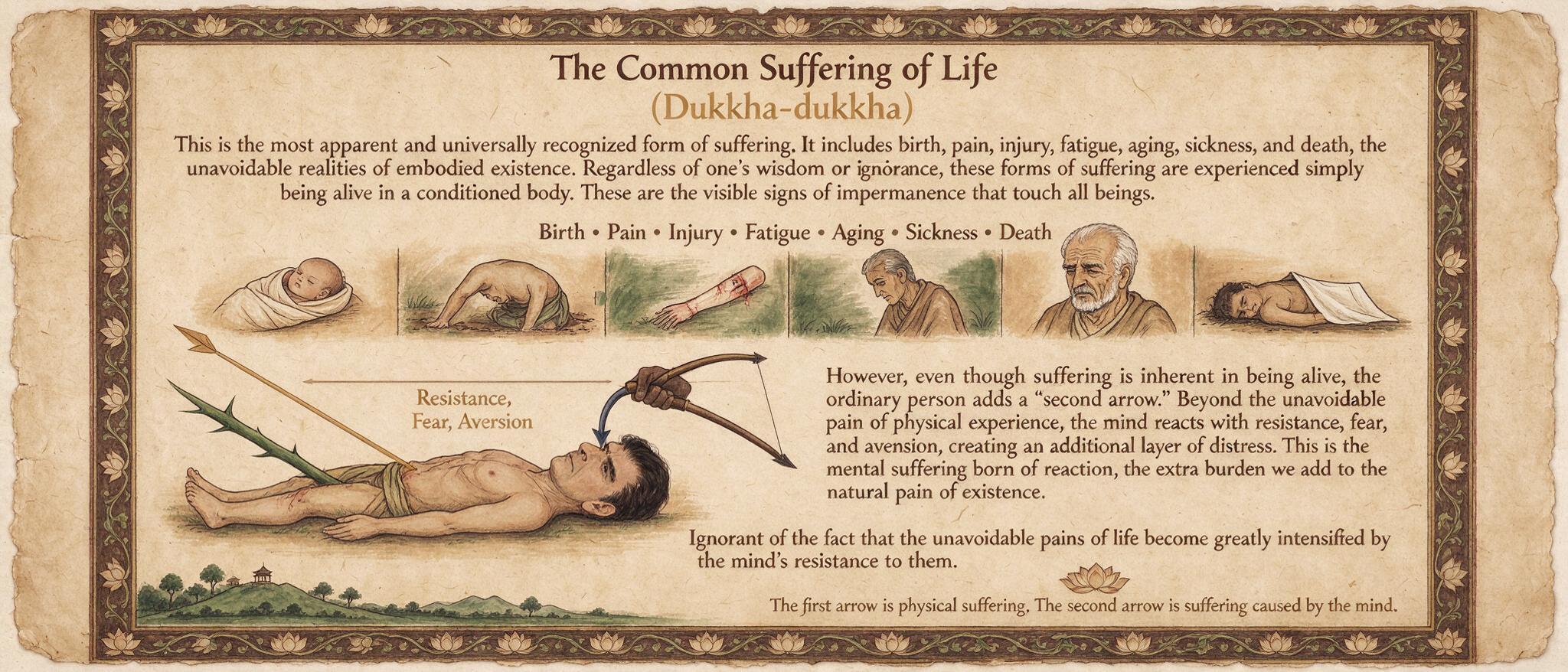
- The Common Suffering of Life (dukkha-dukkhatā)
This is the most apparent and universally recognized form of suffering. It includes birth, pain, injury, fatigue, aging, sickness, and death, the unavoidable realities of embodied existence. Regardless of one’s wisdom or ignorance, these forms of suffering are experienced simply by being alive in a conditioned body.
However, even though suffering is inherent in being alive, the ordinary person adds a “second arrow.” Beyond the unavoidable pain of physical experience, the mind reacts with resistance, fear, and aversion, creating an additional layer of distress. This is the mental suffering born of reaction to pain: the extra burden we add to the unavoidable pains of existence. This is the second form of suffering which arises when we resist unpleasant experiences or cling to pleasant ones. Resistance adds to our pain, while attachment makes us suffer when pleasant conditions change.
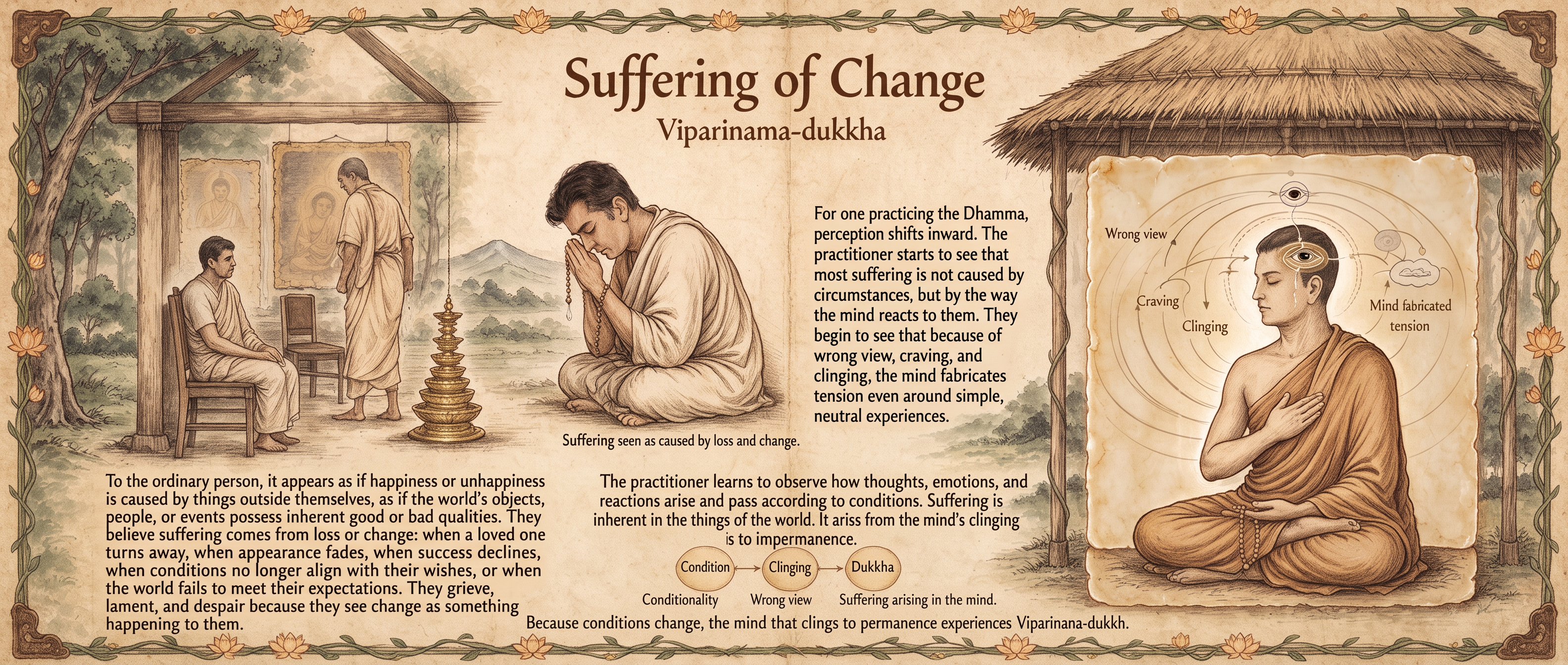
2. Suffering of Change (vipariṇāma-dukkhatā)
This type of suffering arises from the changing nature of the Five Aggregates: form, feeling, perception, mental formations, and consciousness. Because they are unstable, they cannot provide lasting satisfaction. To the ordinary person, this instability appears as if happiness or unhappiness is caused by things outside their mind, as if the body and the world’s objects, people, or events possess inherent good or bad qualities.
They believe suffering comes from loss or change: when a loved one turns away, when appearance fades, when success declines, when conditions no longer align with their wishes, or when the world fails to meet their expectations. They grieve, lament, and despair because they see change as something happening to them.
For an ordinary person, the problem is seen as "out there" something happening outside of them. Life is seen as filled with situations that cause pain. The ordinary person sees suffering as something that happens "to" them, something created by conditions of living in the world. Their attention is on events, not on the process of how the mind relates to them. This kind of suffering is mental in origin. It arises not from events themselves but from wrong views, craving, and clinging to what is unstable. When the mind projects permanence or selfhood onto what is impermanent, disappointment is inevitable.
For one practicing the Dhamma, attention shifts inward. They start to see that much of the suffering is not caused by circumstances alone, but by the way the mind holds on to circumstances and depends on them being a certain way. They begin to see that, because of wrong view, craving, and clinging, the mind fabricates tension even around simple, neutral experiences.
Through mindfulness and investigation, one sees that non-physical suffering is not inherent in the things of the world. The disciple learns to see how thoughts, emotions, and reactions arise and pass according to conditions. They understand conditionality not merely as an intellectual concept but through direct observation of how dukkha arises in the mind from clinging to what is impermanent.
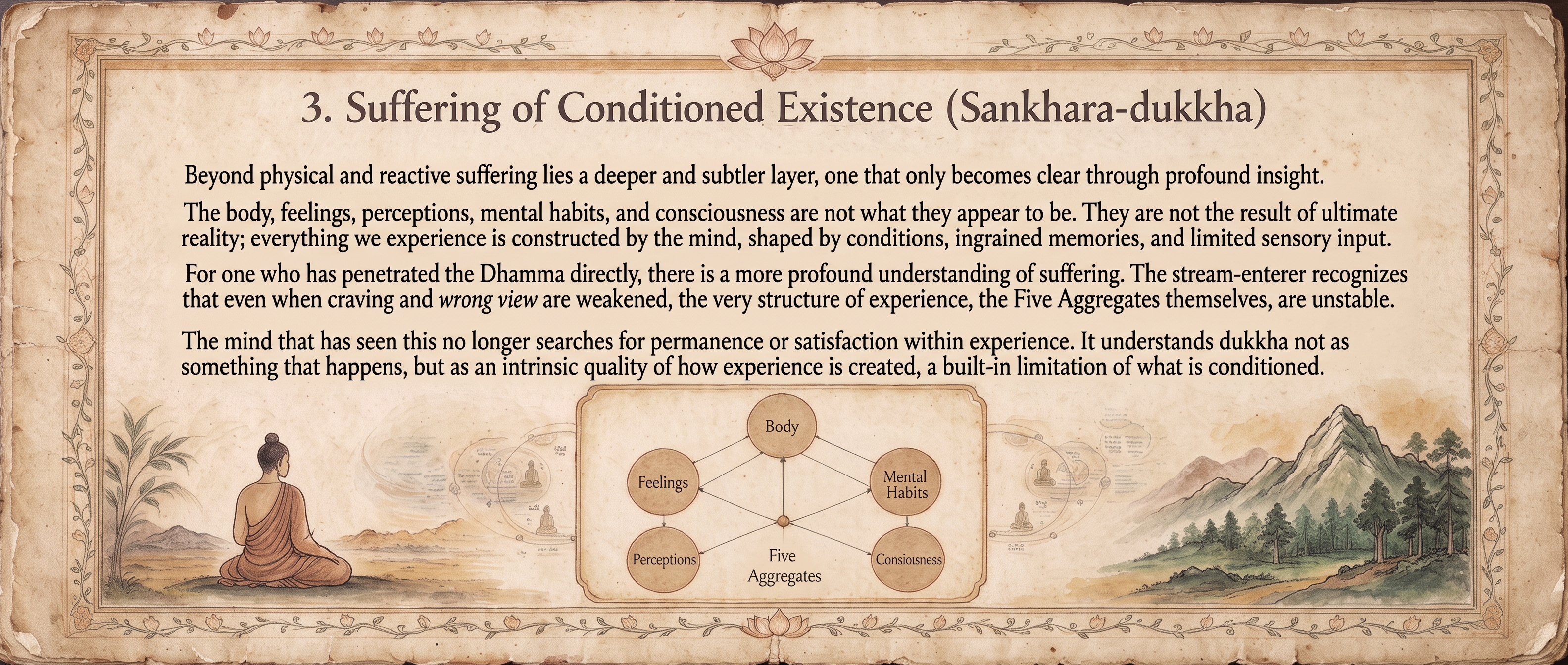
3. Suffering of Conditioned Existence (saṅkhāra-dukkhatā)
Beyond physical and suffering of change lies a deeper and subtler layer, one that only becomes clear through deep insight. This is the suffering inherent in how our mind constructs experience. It does not arise from wrong view or mental reactivity, but from the nature of the Five Aggregates themselves.
The body, feelings, perceptions, mental habits, and consciousness are not what they appear to be. They are not the result of ultimate reality; everything we experience is constructed by the mind, shaped by conditions, ingrained memories, and limited sensory input.
In other words, the Five Aggregates are not reality itself; they are the mind's creation of reality based on craving, ingrained memories and limited sensory input, shaped by past and present causes and conditions.
Because what we experience is conditioned rather than unconditioned, a subtle unease remains even when the mind is calm and craving has been weakened. The aggregates are constructed, subject to change, and incapable of providing lasting peace, so the burden does not fully lift while they are still with us.
For the liberated one this becomes plain. Craving, aversion, and the restlessness they produce are gone, so there is no mental suffering and nothing added on top of pain. But the aggregates themselves are still conditioned. The body still ages and hurts, and experience still changes. What remains is the weight of the aggregates themselves: not suffering in the mind, but the unsatisfactoriness of anything conditioned. The teachings speak of that weight ending only when the aggregates themselves end.
Suffering: Dependent Arising
To understand suffering, we must look at one of the core teachings found in the discourses, Dependent Arising.
While Dependent Arising is a highly complex teaching, we can begin to use it in its more basic form right now. In its simplest expression, “when this is, that is.” When certain conditions are present, certain results follow; when those conditions cease, the results cease too.
It describes how suffering arises and ceases in dependence on conditions. Suffering does not occur randomly, by chance, or merely because of external events. It arises due to specific conditions, and at its core is our clinging to the Five Aggregates.
At a basic level, whatever we depend on sets off a chain — craving, clinging, becoming, the birth of a self — which results in suffering. When we depend on something, there is craving created by our expectations of satisfaction, predictability, and ownership within experience. We depend on the body, feelings, perceptions, and fulfillment of our desires to behave reliably so that we can be happy. When they do not, dissatisfaction is inevitable.
The more conditions we require in order to be happy, the less likely happiness is to occur. When happiness depends on specific circumstances, states, or qualities, it becomes fragile. If those conditions change or disappear, suffering follows — and even when they do not, the happiness lasts only as long as the conditions do. When happiness depends on what is unreliable, happiness itself becomes unreliable.
We can see this clearly by looking at the body. If we depend on having a beautiful body in order to be happy, then aging, illness, or injury do not merely bring discomfort. They take happiness away. Suffering is not created by the body changing but by the dependence we have placed upon it. When we remove dependence on the body as a source of happiness, the body’s changes are no longer a cause of suffering. The body still ages and becomes ill, but our happiness is no longer tied to those conditions.
The same principle applies to the Five Aggregates. Dependent Arising is lived and experienced precisely through them. Form, feeling, perception, mental formations, and consciousness are the field in which dependence is established and suffering arises. The basic teaching is that they are undependable and unreliable. They do not remain the way we want them to remain. Any dependence on them, even at the most subtle level, becomes a cause of suffering. The problem is not that these aggregates exist, but that we cling to and rely on them as a foundation for happiness.
Most of the time, this dependence operates unnoticed. This is where Dependent Arising becomes a matter of direct investigation rather than abstract understanding. We are often unaware of the expectations we have built into experience because they are embedded in our views and assumptions. We assume, usually without reflection, that the body should be healthy, attractive, strong, and reliable at all times. When it is not, we feel that something has gone wrong.
The same assumptions shape our relationship to feeling, perception, and mental activity. When pleasant feelings fade, we assume there is a problem. When perceptions become unclear, when thoughts are disturbed, and when mental states do not function as expected, we experience frustration, disappointment, or distress. These reactions reveal an underlying dependence that has not yet been clearly seen.
What we have not yet understood is the unreliability of the aggregates and the suffering that results from depending on them for happiness. As long as we take them as a support, as long as we rely on them for well-being, they will eventually fail us. This failure is not a mistake or an accident. It is their nature.
The Process of Understanding Dependent Arising
The Gradual Training is essentially a process of understanding Dependent Arising in our own experience and removing dependence on what causes suffering. At its heart, this means weakening and eventually abandoning clinging to the aggregates. This does not happen through force or denial, but through clear seeing. When something is fully understood as unreliable, there is disenchantment and the impulse to rely on it naturally fades.
This does not mean getting rid of the body, feelings, or mental activity. Life continues. Experience continues. What changes is our relationship to these processes. They are no longer treated as sources of lasting happiness. Even at the most subtle level, we no longer place happiness in what cannot sustain it.
When dependence falls away, suffering falls away with it. What remains is freedom that does not rely on conditions being a certain way and therefore does not collapse when conditions inevitably change.
The Five Aggregates: Introduction

The Tathāgata teaches that the root of all suffering lies in craving satisfactory experiences, clinging to the Five Aggregates as “me” or “mine.” But what exactly are these Five Aggregates?
Put simply, the Five Aggregates are how we experience the world: through our body, our feelings, our perceptions, our mental formations, which are our thoughts, intentions, and emotions, and through consciousness.
However, the Five Aggregates are not true reality itself; they are the mind's recreation of reality conditioned by habitual tendencies, ingrained memories and limited sensory input, all shaped by craving. They are called aggregates because they are an aggregate or group of these conditioned tendencies.
Clinging to the Five Aggregates
The teachings call it “clinging to the Five Aggregates” because we mistakenly take these conditional processes to be “me” or “mine.” We assume there is a permanent self at the center, an “I” that experiences everything. The Tathāgata teaches that suffering arises because we fail to see that this self is fabricated: made moment-by-moment by these very processes, not standing behind them. It is not that an “I” does the perceiving; rather, the very process of perceiving creates the sense of “I.”
In other words, experience is not being generated by an “I” interacting with the world; it unfolds through a web of past causes, intentions, desires, habits, and memories. These shape how we contact, feel, perceive, think, and know the world, and they give each of these acts a personal significance: this is happening to me, this matters to me.
The important point is that the sense of self does not stand behind experience, watching it. It is generated within experience itself, in contact, feeling, perception, thought, and knowing. But because it is generated so continuously, and is always with us, we never think to question it. We take the feeling of being someone to be a self — something we simply are.
And yet the aggregates are not “me.” They are not “mine.” They are not fixed or permanent. They are conditioned processes, mistaken for a solid self that experiences the world. The aggregates are the objects of clinging; they are not suffering in themselves, but clinging to them is suffering.
Now, let us look more closely at each of these Five Aggregates in turn.

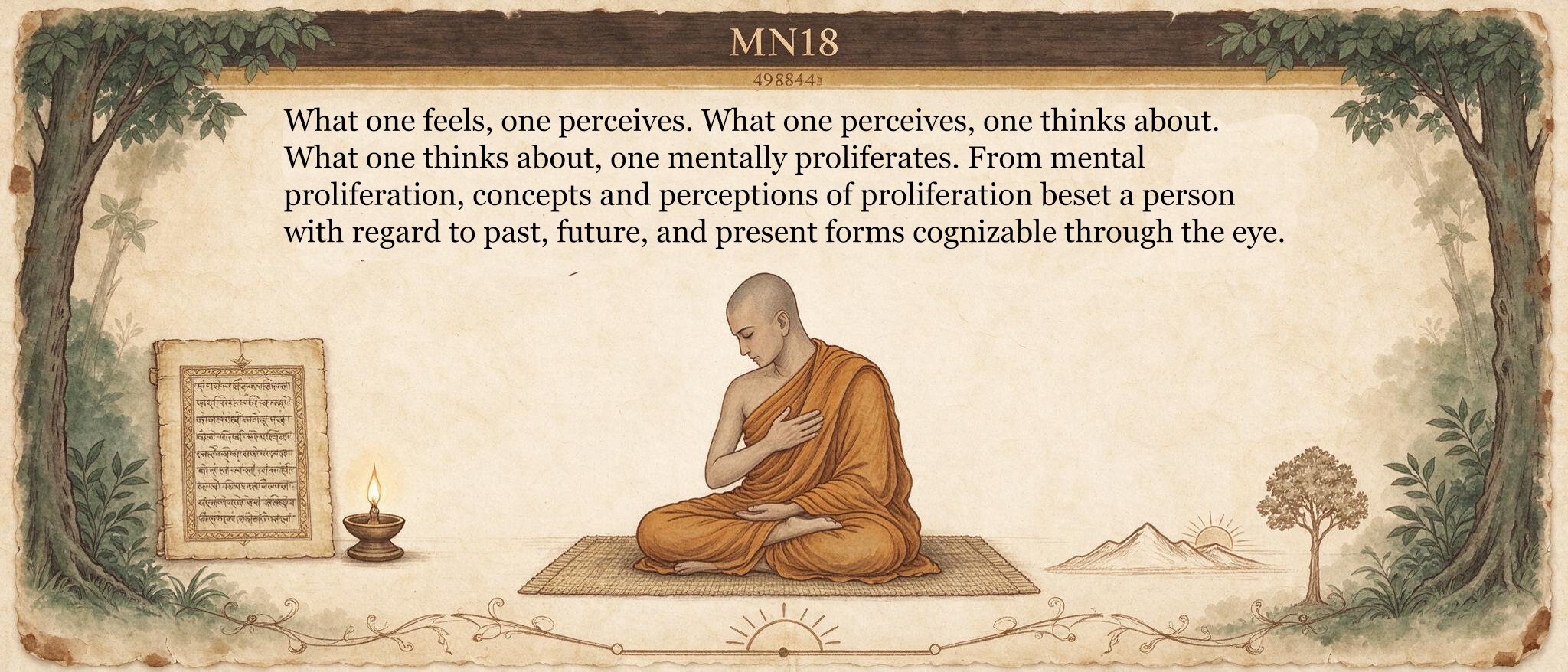
Depending on the eye and forms, eye-consciousness arises; the meeting of the three is contact; with contact as a condition, there is feeling; what one feels, one perceives; what one perceives, one thinks about; what one thinks about, one proliferates. From that as a source, perceptions and notions born of proliferation beset a man regarding past, future, and present forms cognizable through the eye.
MN18
The Five Aggregates: Form
Form refers to the physical aspect of experience: the body, the sense organs, and the material objects we encounter, everything that can be seen, heard, touched, tasted, or smelled.
The first five senses have physical objects. The eye meets light and color, the ear meets sounds, the nose meets odors, the tongue meets tastes, and the body meets sensations such as temperature, pressure, and texture. The mind is different: its objects are mental, images, thoughts, memories, and ideas. These are not physical form, but they shape how form is experienced.
Form is not a fixed thing we possess. What we call the Form Aggregate is the physical side of experience as it is actually met, through the body and the senses. It arises dependent on the sense organ, the object, and consciousness. Light or sound may exist as conditions, but they become experienced form only when they meet a sense organ and consciousness. We do not see color without the eye, the object, and the arising of visual consciousness.
The experience of form is never isolated. It arises together with feeling, perception, intention, and consciousness. The form element can exist externally as a condition, but the Form Aggregate is the experienced form, conditioned by the sense organ, the object, and consciousness.
Here we find the first clue to why suffering arises. The mind does not meet physical reality in a pure, unconditioned way. It meets it through the senses and through its own habitual tendencies, memories, and interpretations. We then cling to that conditioned picture as if it were the whole of reality, or as if the body and the world could be made permanent and secure. Because form is changing and dependent, that clinging cannot bring lasting peace.
The Body, a Bundle of Constantly Changing Conditions
Take the body, for example. We often think of it as a single, solid thing, as "my body." But what we call the body is a process, a continually changing collection of physical phenomena. It’s made up of about 30 trillion human cells, along with countless bacteria, fungi, and microorganisms. It includes organs, muscles, blood, hair, nails, bones, and innumerable parts we rarely even consider. Then there is genetic inheritance, evolutionary processes, and the results of countless past intentions.
So what, then, is the body really? It is not a fixed or lasting entity. It is a temporary coming together of conditions, constantly changing, subject to decay and death. The body itself is not the problem. The problem is that we cling to the mind-created perceptions and memories of the body. We identify with it, we call it “mine,” and we take it to define who we are. This craving, this clinging to the Form Aggregate, how form is experienced, is what gives rise to suffering.
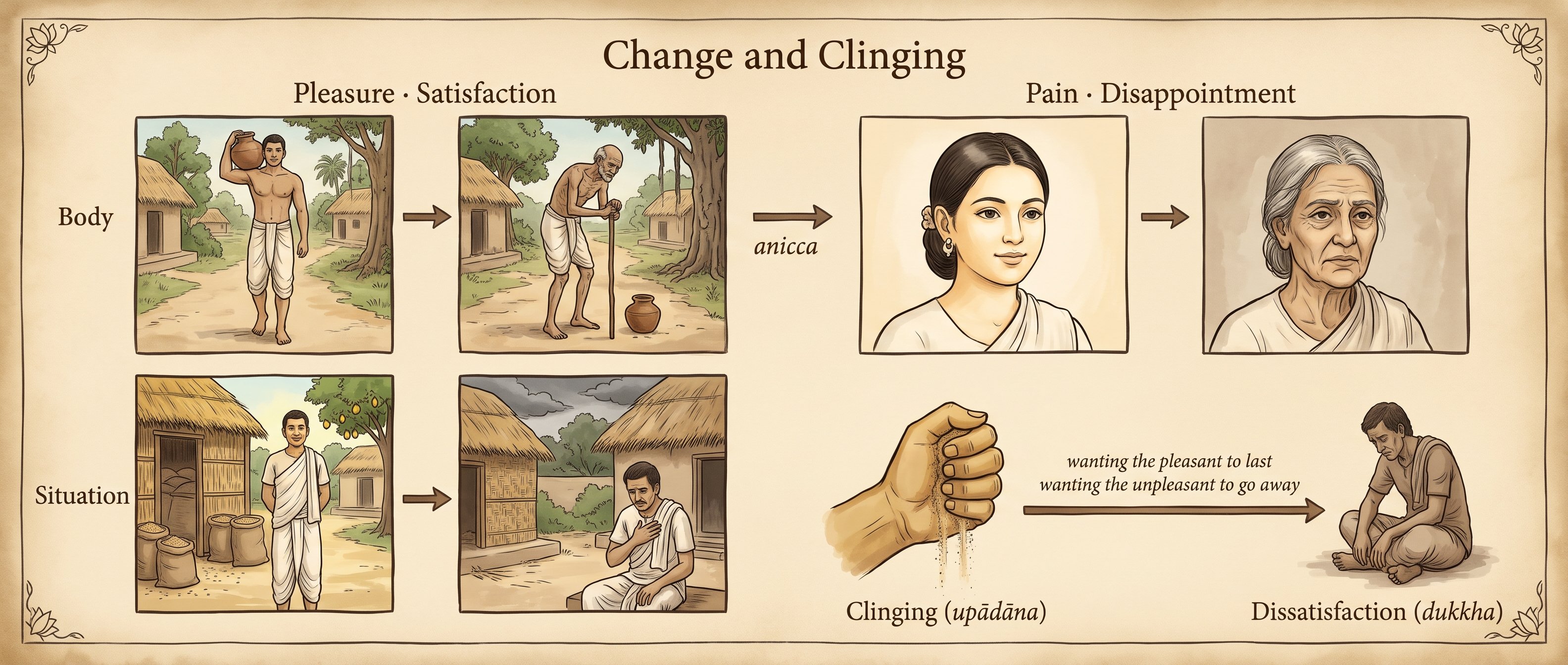
A body that once felt strong becomes weak; a face that once seemed beautiful appears aged; a situation that once delighted us now brings anxiety. Because of clinging, our feelings shift from pleasure to pain and from satisfaction to disappointment, and our perceptions change just as quickly. When we cling to these fleeting experiences, wanting the pleasant to last and the unpleasant to disappear, there is dissatisfaction.
The teachings tell us that it is not physical forms that bind us, but our attachment to our perceptions of them. What traps the mind is the habit of clinging to our experiences of the body and the world, treating what is changing as if it were solid and ours to keep. By holding these passing experiences as “mine,” we create the suffering that comes from trying to hold what cannot be held.
The Hidden Weight of the Body
We live so continuously within the body that we rarely notice the subtle, constant effort it demands. The body must be maintained, balanced, and protected; muscles hold habitual tension; posture and movement require countless small adjustments; the senses respond to contact with the world; and the mind repeatedly reconstructs the sense of “this body,” its boundaries, weight, and position in space. All of this requires constant work, and all of it is inherently stressful.
Because our attention is habitually directed outward, to sights, sounds, people, and tasks, we rarely perceive this inner stress. The background strain becomes normal, invisible, simply “how it is.” And since most people have never experienced even a moment without a body, they cannot recognize the stress that comes with it.
The body is the cause of most of our desires; nearly everything we do depends on bodily needs or bodily activity: eating, dressing, working, playing sports, seeking entertainment, preserving health, and managing our physical appearance.
Having a body sets in motion an entire web of conditions: perception, feeling, craving, identification, expectation, fear, and striving. The body is the root condition for a vast chain of mental and emotional activity. When the sense of “having a body” ceases even temporarily in practice, that whole structure relaxes, not just muscle tension, but the psychological architecture built around embodiment.
This body, householder, is afflicted, trapped within a shell, bound by aging and death. Anyone who, while maintaining this body, would claim even for a moment that it is free from affliction, what else could that be but foolishness?
SN36.6
To have a body is to abide within a chain of conditions. From the body comes contact; from contact, feeling; from feeling, craving; from craving, clinging and becoming. This is how the whole mass of stress and expectation arises.
Because most of us have never known experience apart from being in a physical body, we take this chain for granted. We think the pressure of the world, the pull of desire, and the constant managing of experience are just “life.” Yet when the sense of the body is released, even for a moment, that whole structure relaxes, and in letting go of identification with it, the conditions for much of suffering naturally fall away.
The body is where craving and expectation take hold. To depend on it is to carry a constant readiness to protect, to maintain, and to satisfy. When this readiness stops, there is a profound ease, as if an unseen mechanism has been switched off.
This is why the discourses describe the body as a shell of endless affliction.
The Five Aggregates: Feelings
And what, disciples, is the aggregate of feeling? It is these six classes of feeling: feeling born of eye-contact, feeling born of ear-contact, feeling born of nose-contact, feeling born of tongue-contact, feeling born of body-contact, feeling born of mind-contact. This is called the aggregate of feeling.
SN22.48
Now, let us turn to the second of the Five Aggregates: the Feeling Aggregate.
What do we mean by “feeling” in this context? In the teachings, "feeling" does not refer to emotions like sadness, anger, or joy, as we often use the word today. Instead, it refers to the immediate tone of every experience: whether it feels pleasant, painful, or neither-pleasant-nor-painful. This happens every moment we make contact with the world through any of the six senses, including the mind. Every sight we see, every sound we hear, every thought we think, comes tinged with a feeling tone. Sometimes it’s a subtle pleasure, sometimes discomfort, and sometimes just a neutral hum in the background.
But why is this called an "aggregate"?
It’s called the Feeling Aggregate because our experience of feelings is shaped by past conditioned experiences. Through craving, aversion, and choices rooted in ignorance, we have built up volitional tendencies that condition how we interpret the same sights, sounds, or thoughts differently from others.
For example, someone else may hear a song and feel a pleasant feeling tone, while you hear the same song and feel an unpleasant one. The difference lies not in the sound itself, but the habitual tendencies that condition our feeling response.
As soon as this feeling tone appears in awareness, the mind builds upon it, giving it additional meaning. It sparks perception, recognition, and interpretation. From there, thought arises, and the mind begins to proliferate, spinning stories, shaping narratives, and constructing identity views.
So, the Feeling Aggregate is not just about present experience, it’s also a reflection of the intentions, habits, and tendencies that have been conditioned over time. Our feelings are not random. They arise because certain conditions, internal and external, meet in a particular moment. And crucially, they condition what comes next: whether we crave more, resist what is, or fall into delusion.
This is why feelings are so central in the arising of suffering.
The teachings describe how feelings arise through contact with the six sense bases, namely:
-
Depending on the eye (sight), feelings arise from visual forms.
-
Depending on the ear (hearing), feelings arise from sounds.
-
Depending on the nose (smelling), feelings arise from odors.
-
Depending on the tongue (taste), feelings arise from flavors.
-
Depending on the body (touch), feelings arise from tactile sensations.
-
Depending on the mind (thoughts), feelings arise from mental objects.
When a pleasant feeling arises in an untrained person, they delight in it, welcome it, and remain holding to it. Thus, craving arises.
When an unpleasant feeling arises, they sorrow, grieve, and lament, beating their breast and becoming distraught.
When a neutral feeling arises, they do not discern it as it really is, the arising, subsiding, and gratification of that feeling.
MN10
The three feelings relate directly to the three cravings:
-
Pleasant feeling may condition craving for sensual pleasure.
-
Painful feeling may condition craving for relief or escape.
-
Neutral feeling, when met with ignorance, may sustain craving for continued existence.
These are habitual tendencies, not fixed one-to-one correspondences with the three kinds of craving.
Feelings, the Stress of Reactivity
Just as the body, the Form Aggregate carries its own built-in strain through the work of maintaining embodiment, the Feeling Aggregate carries the stress of reactivity, the ceaseless rising and fading of pleasure, pain, and neutrality that keeps the wheel of craving turning.
When touched by a feeling of pleasure, one delights in it; when touched by a feeling of pain, one sorrows. When touched by a neutral feeling, one is confused. But when a disciple sees the rise and fall of feelings, he is freed, for he knows: ‘Whatever is felt, this too is suffering.’
SN36.6
Feelings are Suffering
Every moment of sense contact, a sound, a taste, or a thought, gives rise to a tone of pleasure, pain, or neither. The untrained mind cannot rest with this; it immediately leans toward pleasure, resists pain, or drifts into dull indifference. This very leaning is suffering itself.
We usually don’t notice the strain that feeling brings because it happens so quickly. The reflex of liking and disliking feels natural, and we instinctively attribute the feeling to the object or event itself, thinking the thing is pleasant or unpleasant, without realizing that the feeling has been created by the mind.
But when the mind grows still and mindfulness deepens, we begin to see that every feeling, even pleasant ones, carries a thread of tension. Pleasant feelings bring the stress of wanting to keep them, painful feelings bring resistance, and neutral feelings bring subtle restlessness or boredom. The mind is always being pulled somewhere.
When feeling quiet, when we observe it without chasing or rejecting, an unexpected ease appears, and the habitual pulling stops. Then we understand what the teachings meant when they spoke of “Whatever is felt is included within suffering.”
By clinging to feelings, we keep the wheel of suffering in motion. But when feelings are fully known, clearly seen, and released, craving no longer follows, and the whole process of becoming begins to unravel.
The Five Aggregates: Perceptions
And what, disciples, is the aggregate of perception? It is these six classes of perception: perception of forms, perception of sounds, perception of odors, perception of tastes, perception of tactile objects, and perception of mental phenomena. This is called the aggregate of perception.
Perception is more subtle than feeling. It’s the act of recognition and labeling, the way the mind interprets raw experience: “This is pleasant,” “this is danger,” “this is me,” “that is other.”
Perception is a present-moment process of recognition and labeling. Although it arises dependent on contact, it is conditioned by previous experience, particularly past craving and aversion. These leave latent tendencies that influence how we recognize, interpret, and react to what we encounter in the present.
Perceptions Arising with Contact
Perceptions and feelings arise together based on contact with the six sense bases:
-
Depending on the eye (seeing), perceptions of visual forms arise.
-
Depending on the ear (hearing), perceptions of sounds arise.
-
Depending on the nose (smelling), perceptions of odors arise.
-
Depending on the tongue (tasting), perceptions of flavors arise.
-
Depending on the body (touching), perceptions of tactile sensations arise.
-
Depending on the mind (thinking), perceptions of mental objects, such as ideas, memories, and concepts, arise.
The discourses describe perception as a mirage, alluring but deceptive, because it creates the world we then suffer inside.
Perception, disciples, is like a mirage. What a man with good eyesight sees in the heat shimmer, that a fool might take for water. So too, what is called ‘perception’ is empty, void, without lasting substance.
SN22.95
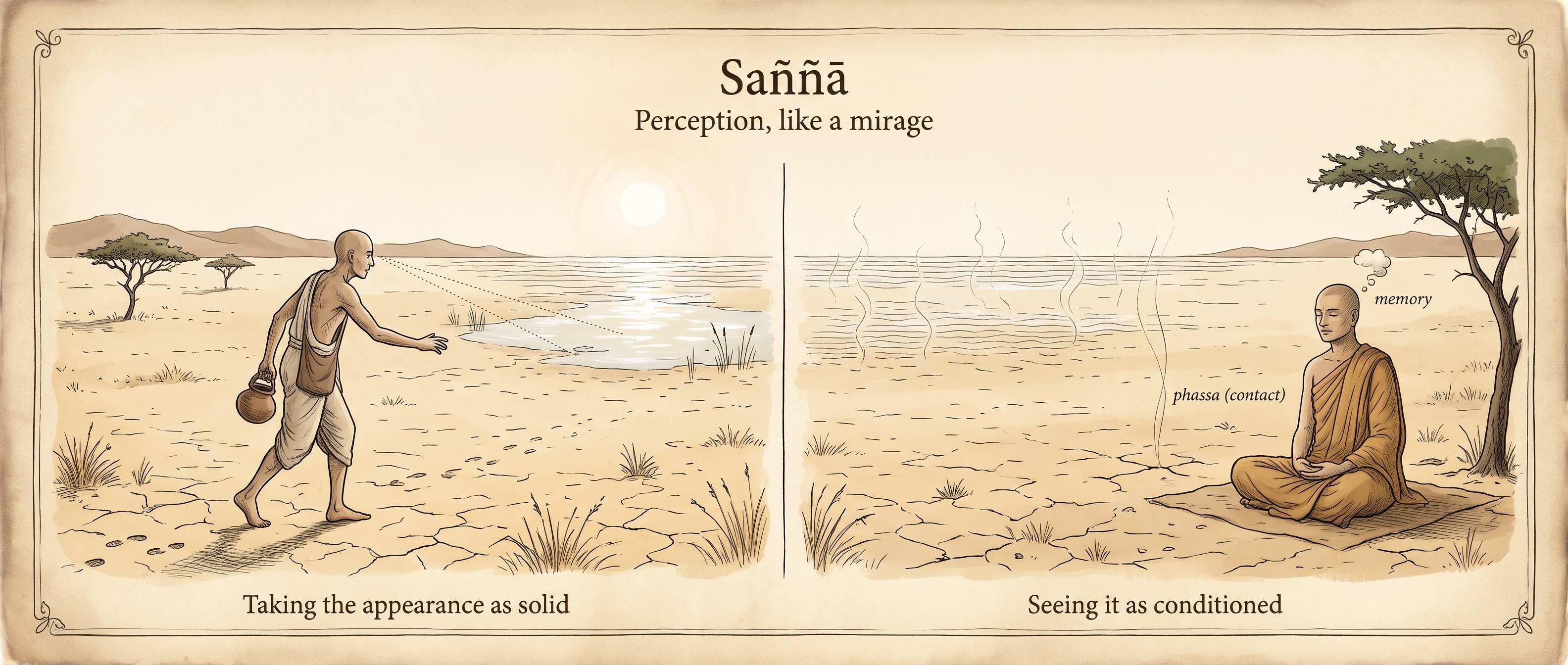
Perception is the mind’s act of shaping the world, recognizing, naming, and forming images out of the stream of experience. This seems innocent, even necessary, yet it carries a quiet tension: every perception builds and reinforces a world of distinctions pleasant and unpleasant, self and other, mine and not mine. Through this continual labeling, the mind freezes fluid reality into fixed forms and then must live inside those forms. Because this process happens instantly and automatically, we rarely notice its strain. The mind is constantly measuring, comparing, affirming, and defending its pictures of reality. We see a face and immediately recall a story; we hear a sound and name it; we meet a feeling and judge it. This endless mental shaping is exhausting, yet we mistake it for simply “seeing the world.”
When perception quiets, when recognition stops reaching for names, there’s a remarkable peace, an openness unconfined by mental images. The mind stops building and starts simply knowing. In that silence, one sees that the act of “making things into things” was itself a subtle bondage. The discourses describe perception as “like a mirage” because it seduces us into chasing appearances, into believing the mind’s creations are solid. To see perception for what it is, a mirage arising in dependence on contact and memory, is to understand why it is unsatisfactory. As long as we take perception to reveal fixed truth, we must defend our versions of reality. When we see it as conditioned, we relax our grip, and that relaxation is freedom.
Perception is also the driver of conceptual proliferation, the mind's tendency to spin out endless categories, comparisons, and self-referential narratives. Seeing perception clearly is the first step toward the cessation of proliferation.
And what, disciples, is the aggregate of perception? It is these six classes of perception: perception of forms, perception of sounds, perception of odors, perception of tastes, perception of tactile objects, and perception of mental phenomena. This is called the aggregate of perception.
The Five Aggregates: Mental Formations
And what, disciples, are mental formations? There are these six classes of volition: volition regarding forms, sounds, smells, tastes, tactile objects, and mental phenomena. These are called mental formations.
SN22.79
Now we turn to the Mental Formations Aggregate, perhaps the most intricate and influential of all the aggregates.
While form, feeling, and perception describe what we experience, Mental Formations describe how we build experience, the constant undercurrent of intentions, reactions, habits, and the habitual tendencies that shape the mind moment by moment.
The teachings call this the engine of becoming, the silent craftsman that fashions the sense of self and world.
Mental Formations interact closely with the other aggregates:
-
Form: Intentions influence and are influenced by physical actions.
-
Feelings: Feelings condition responses to experiences.
-
Perceptions: Perceptions guide the intentions formed by mental formations.
-
Consciousness: Mental formations shape the continuity of consciousness and are shaped by it in return.
Whatever one intends, whatever one plans, whatever one has a tendency toward: this becomes a basis for the maintenance of consciousness. When there is a basis, there is the support for the establishing of consciousness. When consciousness is established and has come to growth, there is the production of renewed existence in the future.
SN12.38
Mental Formations are the countless micro-movements of intention that ripple beneath awareness, the tightening of wanting, the resistance to pain, and the constant drive to arrange experience into something more bearable or more pleasing. They are the fabricators of the lived world.
Because Mental formations operate so continuously, we mistake them for the experience of being alive. They are the effort behind every becoming: the impulse to control, to plan, to judge, to maintain an image, and to escape what we dislike. This never-ending construction is stressful because it is compulsive, built on craving, ignorance, and the assumption of “I am.”
To understand Mental Formations more clearly, it’s important to recognize that they are deeply shaped by the accumulated momentum of past desires and intentions.
These past habitual tendencies leave behind karmic imprints, latent tendencies that predispose the mind toward certain reactions and behaviors. These tendencies don’t just sit passively in the background. They influence how we perceive the present moment and how we respond to it.
For example, someone with a strong habitual tendency toward anger might encounter a frustrating situation. The perception of that situation feels unpleasant. That feeling then gives rise to irritation. Irritation quickly conditions a new angry intention. And that intention not only leads to immediate words or actions, it also strengthens the underlying habit of anger.
This is how, over time, repeated intentions solidify into habitual mental patterns. These patterns, in turn, influence how we respond to new experiences, continuing and reinforcing the cycle of suffering.
When ignorance is present, we fabricate endlessly, constructing identities, emotions, and stories. When ignorance fades, the mind stops fabricating the unnecessary. The sense of strain, of “holding the world together,” lessens, and the mind becomes at ease.
The discourses distinguish three types of formations: bodily, verbal, and mental. An arahant still has functional formations (breathing, intending to walk, etc.) but no kammically potent formations rooted in greed, aversion, and delusion.
The Five Aggregates: Consciousness
The Consciousness Aggregate refers to the mental process of awareness, of knowing. It plays a central role in generating the perception of a separate self, one that experiences, interacts with, and stands apart from the external world.
But it’s important to understand: consciousness is not a continuous, ever-present stream. It doesn’t run in the background like a single unbroken light.
Instead, consciousness arises moment by moment, like a flickering light bulb, each time there is contact between a sense base and a sense object. When the eye meets a visible form, eye-consciousness arises. When the ear meets a sound, ear-consciousness arises. And so on, through all six sense doors, including the mind.
This flickering happens with incredible speed, so fast that they give the appearance of continuity. But in truth, each moment of consciousness arises, ceases, and gives way to the next, conditioned by what came before.
And yet, because we do not see this clearly, we build a sense of identity around it. We think, “I see.” “I hear.” “I think.” But there is no fixed “I” behind these processes, just fleeting consciousness tied to contact, shaped by kamma, and empty of any inherent self.
And what, disciples, is consciousness? These six classes of consciousness are eye-consciousness, ear-consciousness, nose-consciousness, tongue-consciousness, body-consciousness, and mind-consciousness. This is called consciousness.
SN22.79
Consciousness is categorized into six types, each corresponding to the six sense bases:
-
Eye-consciousness: the awareness of visible forms.
-
Ear-consciousness: the awareness of sounds.
-
Nose-consciousness: the awareness of smells.
-
Tongue-consciousness: the awareness of tastes.
-
Body-consciousness: the awareness of tactile sensations.
-
Mind-consciousness: the awareness of mental objects, thoughts, and emotions.
Each type of consciousness arises dependently upon the corresponding sense organ and object, for example, eye and form for visual consciousness, or ear and sound for auditory consciousness.
It’s also important to note that no two types of consciousness can arise at the same time. For example, eye-consciousness arises only when there is contact between the eye and a visible form. Ear-consciousness, on the other hand, arises when the ear contacts sound. These are distinct events. They do not overlap or happen simultaneously.
Rather, they arise and cease in rapid succession, one after another, like individual sparks lighting up and fading out. The mind quickly shifts attention from one sense door to another, creating the illusion of a continuous stream of awareness.
But in reality, each type of consciousness is conditioned, dependent, and momentary, arising only when the right contact occurs and ceasing just as quickly when that contact ends.
Understanding this reveals something profound: that our sense of a continuous, stable “self” is constructed from these ever-changing flashes of consciousness. There is no observer behind the process, just the process itself, arising and passing away.
Clinging to Consciousness Causes Suffering
Consciousness is often mistaken as the ultimate self, the “knower” behind experience. But the teachings reveal that this, too, is woven out of conditions. Consciousness arises dependent on contact with an object: eye-consciousness with form, ear-consciousness with sound, and mind-consciousness with thought. When the object fades, the consciousness associated with it fades too.
Because consciousness flickers so rapidly, we experience it as a continuous stream. This illusion of continuity gives rise to the deep belief, “I am the one who knows.” Yet this “knower” is itself a fabrication, a mirroring of the contact between sense base and sense object, continuously renewed.
The suffering lies in the clinging to continuity. The mind silently works to sustain the sense of being a continuous observer, a subtle, ongoing act of fabrication. It is a quiet but constant strain, like keeping a spinning wheel in motion. Even refined states of Jhana, luminous and blissful, still depend on the maintenance of consciousness.
When this process is seen clearly, the mind naturally releases it, not by destroying consciousness, but by ceasing to identify with it.
Where consciousness is not established, and name-and-form do not gain a footing, there is no growth of birth, aging, and death.
SN12.64
This is the stilling of the most fundamental movement, the turning of awareness upon itself as “I.” When consciousness is understood as dependently arisen, the illusion of an abiding self dissolves. What remains is the peace the Tathāgata described as Nibbāna, not annihilation, but the unbinding of the mind from conditions.
When the mind sees the arising and passing of these Five Aggregates without clinging, the whole structure of “I” and “mine” loses support. The stress that came from defending, maintaining, and defining the aggregates dissolves. What remains is Nibbāna, the stilling of all formations, the relinquishment of all clinging, the fading away of craving, and the cessation of suffering. Thus, the liberation taught in the discourses is not about improving or purifying the aggregates but about seeing them clearly and relinquishing them.
The Five Aggregates: Consciousness Like a Monkey in the Forest
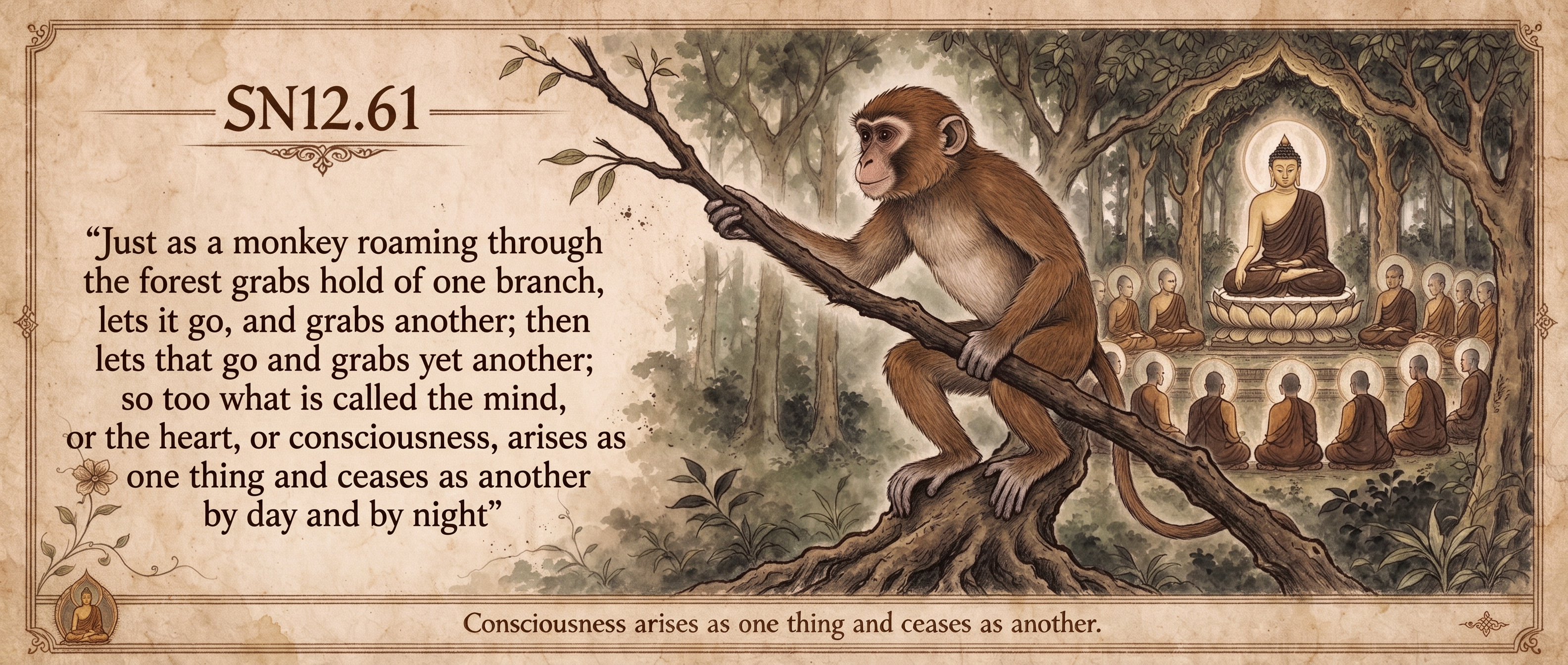
This simile is a direct instruction on how to see consciousness as it actually operates, moment by moment.
The monkey does not carry a branch with it. Each grip exists only while it is being held. Once released, it is gone completely. The next branch is not a continuation of the previous one; it is a new act of grasping, conditioned by what is immediately available. Consciousness functions in exactly this way.
Consciousness is always specific
Consciousness is never a general awareness or a background observer. It is always tied to conditions. Eye consciousness arises dependent on eye and form. Ear consciousness arises dependent on ear and sound. Mind consciousness arises dependent on mental objects.
Each instance is discrete. Visual consciousness does not turn into auditory consciousness. A thought does not morph into the next thought. One moment ceases, then another arises elsewhere, dependent on new conditions.
Nothing travels forward.
The assumption of the knower
The simile corrects a subtle assumption. We tend to think consciousness changes, as if one enduring knower shifts its attention. The discourse points to something more radical. Consciousness is replaced.
Each arising is new. Each ceasing is final. What gives the impression of continuity is speed and clinging. The mind stitches together these rapid arisings and imputes an owner, a watcher, a self who seems to move from branch to branch.
But there is no monkey apart from the grabbing.
Why this undermines self-view
If consciousness were stable, it could be taken as self. If it endured, it could be owned. But what arises only to vanish cannot serve as a ground for identity.
There is seeing, then no seeing. There is thinking, then no thinking. There is hearing, then no hearing.
No observer remains in between.
When this is not seen clearly, clinging forms. Consciousness leaps toward pleasant sights, sounds, and thoughts, just as the monkey grabs whatever branch is closest. This fuels craving and keeps the cycle moving.
Seeing this in practice
As attention becomes steady, gaps become noticeable. A sound ends, and there is nothing. A thought dissolves and does not leave a trace. Another thought may arise later, but it is not carried over by anything.
We do not experience a consciousness waiting. We experience arising and ceasing.
At that point, the simile stops being an idea and becomes a description of lived experience. The sense of an enduring consciousness weakens, and with it, clinging loosens. When seen directly, it leaves nothing solid behind to hold onto.
The Five Aggregates: Should Not Be Mistaken as Self
As we have already seen, the main cause of suffering is clinging to the Five Aggregates: form, feeling, perception, mental formations, and consciousness, depending on them, making them self. We assume, “This is me,” or “This belongs to me,” and look to these conditioned experiences for lasting security and happiness.
Clinging to the Five Aggregates is the habit of taking these conditioned processes to be our self, a core identity that experiences what is happening. It includes both the view “this is me, this is mine” and the craving and aversion that hold that view in place. We assume that the body, feelings, perceptions, intentions, and cognition make up who we are, that they form a self or an essence, and that this self is the one interacting with the world.
People mistake the experiences felt and perceived through the Five Aggregates as someone interacting with something external. Suffering arises because, although there is a physical world, we add personal significance to our experiences: “this is for me,” “this is against me,” “this is mine.” That added significance is shaped by craving and aversion. Without craving and aversion, experience would still have its own characteristics, but it would not carry the sense “this is me, this is mine.”
Because this isn’t clearly seen, people pursue happiness, believing it exists in external objects or experiences. They don’t realize that the personal significance they give to happiness and unhappiness, and to their judgments, is shaped within the mind by habitual tendencies rooted in greed and aversion, not by an underlying self, and not by the objects or experiences themselves.
When we begin to contemplate the nature of the Five Aggregates, it becomes clear: the personal significance that we’ve assumed to be part of the outside world is actually a creation of our own minds. It is the result of past habitual tendencies, desires, intentions, and present cognition that give significance and make what appears in experience appear as "me, myself or mine". Instead of seeing that the aggregates are conditioned, we mistake the aggregates for a "me" experiencing reality.
Through contemplation, we begin to see that this sense of self, a separate person interacting with the world, is an illusion caused by clinging to these ingrained mental formations and memories, that give personal significance to our experience.
Nāma-Rūpa and the Roots of Suffering
In the teachings,the world is experienced through the coming together of mind and form (Nāma-Rūpa). Our experience of the physical world, forms, sounds, tastes, touches, and smells, arises dependent on the body and its sense organs. The mind does not know the physical directly; it only knows contact, the meeting of sense object, sense faculty, and consciousness. From this contact arise feeling, perception, and thought, the building blocks of mental experience. This is how the mind is constantly recreating the world internally; it constructs a representation of the physical through the lens of its own conditioning.
But this fabrication can never accurately represent physical reality. The mind only knows what arises within its own domain, a mental object, not the object itself. When we cling to mind-created perceptions, feelings, and thoughts, we cling not to the ever-changing world as it truly is, but to snapshots the mind has created.
Suffering arises because the mind’s representation of reality, colored by desire, aversion, and delusion, can never match the dynamic, changing nature of things. When we cling to these mental fabrications as “real” or as “mine,” we bind ourselves to a distorted world of concepts and memories, which causes suffering.
Liberation from suffering, therefore, comes from seeing directly, from knowing body as body, feelings as feelings, perceptions as perceptions, and thoughts as thoughts, seeing them for what they are and not mistaking them as "me, myself or mine."
The Five Aggregates: Fabrication of Reality
To understand why we experience is fabricated, let's look at a modern perspective on why the mind constructs experience the way it does.
Consider that phenomena like time and space, and our sense of self as a separate being apart from the objects of the world, are not inherent in light waves entering our eyes or sound waves reaching our ears. This three-dimensional world, where we perceive ourselves as distinct from everything else, is reconstructed in consciousness through nāma-rūpa.
It is a reconstruction, shaped to serve survival: to help us interact with the environment and to make potential objects of desire stand out from everything else around us.
Over time, all beings have adapted to fulfill the desire to survive, shaping how they feed, how they reproduce, what they like, what they dislike, and how they behave. This survival-driven adaptation requires the mind to ignore most of the vast sensory information available in the environment, and to enhance only what is most important, especially for feeding and reproduction.
For this purpose, the mind makes certain forms appear attractive and certain feelings pleasant, for instance, sexual pleasure to ensure reproduction, pleasant tastes for nourishing foods, and aversion toward things that signal danger. These feelings and perceptions help highlight what is important for survival, making certain objects stand out against the background of the world.
So, even at its most basic level, mere existence as a being gives rise to ordinary suffering, the physical and emotional pain experienced through birth, hunger, fear, aging, illness, and death. This suffering is intensified by the natural competition for resources among beings: the struggle for food, territory, control, and sexual partners. These natural processes are inherently unsatisfactory, for they unavoidably involve both physical and mental discomfort.
The Human Realm
In the human realm, the pressure from parents, friends, society, culture, institutions, advertising, and social media has magnified greed to levels unimaginable in earlier times. We have come to hold an unquestioned belief that happiness lies in indulging in food, sex, wealth, power, popularity, beauty, or any number of endless pursuits that feed sensual and mental cravings. Yet all these mind-created indulgences only add to our stress and place more obstacles in the way of happiness and liberation.
Yet although feelings and perceptions may seem completely natural and a necessary part of life, we rarely recognize how much inherent suffering they contain. What we find pleasant today may become unpleasant tomorrow; what once brought joy can later bring disappointment or loss. The sweetness of taste can turn to craving and overindulgence; affection can turn to attachment and fear of separation; aversion can harden into resentment or hatred. Because feelings and perceptions are constantly changing, and because we cling to them as real or dependable, they give rise to anxiety, tension, and restlessness.
The Five Aggregates: Language and the Mind Created World
Another way that the suffering of change arises is by our use of and dependence on language.
Language, the tool that allows humans to communicate and interact using words, is an abstract representation of a mind-created reality. While language has made humans highly successful and efficient at exploiting their environment, it has also created a layer of abstraction in which people interact within a mind-made world, making humans even more detached from physical reality and natural forces.
Language reinforces the subject–object relationship. It strengthens the illusion that there are objects to be desired and a self who desires them, that there is a doer and things to be done, a thinker and thoughts to be thought.
Instead of seeing that all things are the result of natural causes and conditions, ever-changing and without permanence, people take things personally. They cling to words, static representations of what is fluid, and because of this clinging, words have the power to completely shape a person’s moods, thoughts, and actions, even though they are not based on any underlying reality.
The Language Made World
We live in a language-created world, driven by desire and detached from natural reality without realizing it. We believe that what we think and the words we speak can represent true reality, unaware that words are merely fabrications of the mind. Language gives structure to experience, but not truth to it. Words arise after perception; they point toward things, but never touch them. The moment we name a thing, we have already stepped away from the living reality of it.
Relying on words as if they hold essence, we mistake labels for life, signs for substance. We become attached to opinions, stories, and identities built on linguistic constructs, thinking that they mirror the world as it is. In doing so, we dwell not in the freshness of the present, but in echoes, concepts shaped by memory and imagination. This is proliferation of thoughts and meanings, the tangle of conceptual proliferation that fuels craving, aversion, and views.
This is how speech and thought propagate suffering. Words, if clung to, become barriers between mind and reality, imprisoning awareness in abstraction. We fight over words, defend views, and mistake linguistic distinctions for ultimate truths. Thus, the more we rely on language to define reality, the further we drift from seeing things as they are.
The wise, therefore, use speech not to build delusion, but to dismantle it, to guide the mind toward direct knowing. Words should be like fingers pointing to the moon: useful only insofar as they direct vision to what lies beyond them. When speech is used to reveal rather than conceal, to still the mind rather than agitate it, it becomes part of the path rather than a source of bondage.
Desires: Their Unsubstantial Nature
Now this is the noble truth of the origin of suffering: It is this craving which leads to renewed existence, accompanied by delight and lust, seeking delight here and there; that is, craving for sensual pleasures, craving for existence, craving for non-existence.
SN56.11
At the root of all suffering is craving. It is craving that leads to clinging to the Five Aggregates.
What the teachings call craving, also spoken of as delight, lust, or greed, arises because we have not seen the true nature of desire. We fail to recognize that the objects of desire, and the satisfaction they promise, are ultimately unsatisfying, insubstantial, ever-changing, and unreliable, and that pursuing them can only lead to stress and dissatisfaction.
Instead, because of ignorance, we place our trust in what we experience through the Five Aggregates, believing our experiences to be substantial, real, and dependable, things we can grasp and cling to for happiness. We have not seen that the pleasure we find in things is created in the mind and does not exist independently in the objects themselves.
We mistakenly believe there must be a way to get what we desire, to obtain happiness from the world by securing and controlling things. We have not realized that the desirability we see in them, the happiness we expect from them, the value we place on controlling them, and even the sense of self itself are all shaped by the mind. None of these exists as an independent reality outside it.
Craving Blinds Us From Reality
When we cling to the body, our feelings, perceptions, intentions, and thoughts, this creates the illusion of continuity and the belief in a “self” as an enduring entity with a unique essence. As a result, we unquestioningly believe our feelings, perceptions, and thoughts are real, that they are ours, and that they can be relied upon to see the truth and bring happiness. Because of this, we become entangled, lost in the pursuit of desires, all the while ignoring the stress, unhappiness, and dissatisfaction this very clinging creates.
For example, a person blinded by the thought that money will bring happiness may chase after wealth, not to put it to practical use, but simply to amass as much as possible. In their mind, money becomes synonymous with happiness. In the process, they become blind to the stress and suffering they create for themselves, blaming problems on external circumstances or other people. Never satisfied, they continue chasing the delusion created by clinging to mind-made perceptions, feelings, intentions, and thoughts, in short, clinging to the Five Aggregates, while ignoring the unhappiness that desire inevitably brings.
In the same way, we no longer seek food simply to nourish the body; we chase tastes themselves. Blinded by greed, we seek the idea of sex for its own sake. Greed clouds our vision so that we do not see people as they truly are, but only as they appear: “rich,” “poor,” “powerful,” “successful,” “beautiful,” or “ugly.” We chase these mind-made attributes, none of which exist in nature, and as a result, we suffer. This too is clinging to the Five Aggregates.
A liberated person, by contrast, understands that nothing in this world has an intrinsic nature of beauty or ugliness, tastiness or distastefulness, such judgments are products of ingrained memories, volitional formations, and desires created by the Five Aggregates.
In other words, the world is "empty" of self and what belongs to self, not empty of characteristics.
Such a person may still enjoy food, fragrances, and other experiences but sees through the distortions and enhancements of perception and thought as fabrications. Their mind does not react or cling to other people’s words, actions, or any part of existence based on these illusions. Instead, they see the underlying reality: the Five Aggregates are unreliable, fabricated, and not-self, and perceptions and thoughts are harmless when understood in this light.
Clinging to the Undesirable
Just as we cling to what we find desirable, we also cling to what we find unpleasant. Instead of seeing the underlying reality of experiences, we fixate on their perceived unpleasant features. We might, for example, reject healthy food simply because it lacks the taste we desire, ignoring the long-term harm caused by unhealthy eating.
When unpleasant sensations arise, we cling to their unpleasantness rather than seeing the truth of impermanence and not-self. This clinging only increases our stress, discomfort, and suffering.
The desire for things to be one way or another fuels unhappiness. Whenever we encounter unpleasant experiences, we try to escape by seeking out pleasant ones: food, entertainment, alcohol, drugs, sex, daydreams, and more.
But due to ignorance, we believe these pleasant experiences contain some inherent desirable quality. In truth, that desirability is a product of the mind. Such pleasures feel pleasant only because they temporarily relieve the underlying stress created by trying to satisfy desire.
And so the cycle continues: endlessly chasing desires, clinging to moments of pleasure, yet ending in dissatisfaction. This is clinging to the Five Aggregates.
Delusion persists because, even though life constantly shows us that our likes and dislikes, our views, thoughts, and actions cannot fully satisfy us or align with the truth of the physical world, we ignore this truth. Instead, we strengthen the sense of self, blindly pursuing satisfaction while overlooking the stress, unhappiness, and suffering created by that very pursuit.
Craving: Attachment to Desires
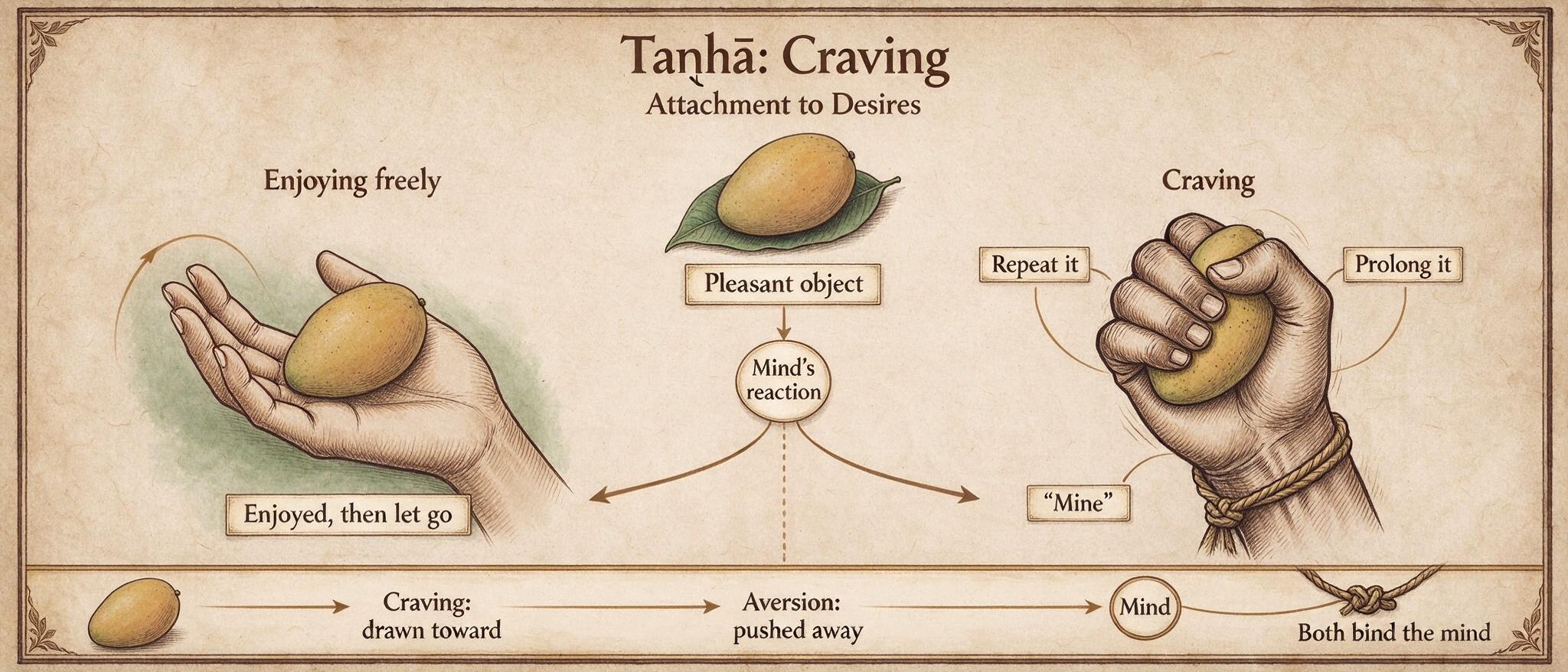
It is important to understand that the objects of the world are not the problem. Pleasure does not inherently exist in what we see, hear, or touch; it lies in how the mind reacts to these experiences.
Suffering comes from the intention behind our desires: the craving to have more, to repeat a good experience, or the urge to claim something as “mine.”
When we become attached to experiences, they begin to control us. Enjoyment shifts from something we experience freely to something we cling to. This is why the desire for sensory pleasure is not about the objects themselves, but about the way we latch onto them.
The teachings do not reject pleasure but caution against becoming entangled in it. If we misunderstand this, we might assume self-denial is the solution, but that is not the answer. The true challenge is the mind’s tendency to become obsessed, attached, and lost in craving.
We can still enjoy life wisely, appreciating good moments as long as they remain free from intoxication, identification, and craving. Of course, this is easier said than done, which is why we must examine our experiences closely to see whether craving is present.
Craving for Sensual Satisfaction
Craving for sensual satisfaction is not about sensory contact itself; it is about our mental reaction, lust, craving, attachment, delight, and obsession, toward experiences that please the senses. It manifests as:
-
The desire to repeat or prolong an experience
-
Identification with pleasure (“this is my enjoyment”)
-
Mental delight
-
Addiction-like attachment
Craving is not merely liking something; it is being drawn in by it, compelled toward it, and clinging to it. Likewise, aversion is not simply disliking something; it is being pushed away by it, resisting or clinging to its absence. Both craving and aversion bind the mind to suffering.

Contemplating Sensual Pleasures
Sensual pleasures have been described by me as having little delight, much suffering, much despair, and the danger in them is even greater.
Sensual pleasures have been compared by me to a skeleton... Sensual pleasures have been compared by me to a piece of meat... Sensual pleasures have been compared by me to a torch of grass... Sensual pleasures have been compared by me to a pit of burning coals... Sensual pleasures have been compared by me to a dream...
I have described desires as like a borrowed well... I have described desires as like tree fruits... I have described desires as like a sword's edge... I have described desires as like a spear's point... I have described desires as like a snake's head, full of suffering and trouble, with more danger therein. - MN22
Sensual Pleasures
Kamma: Action and Result
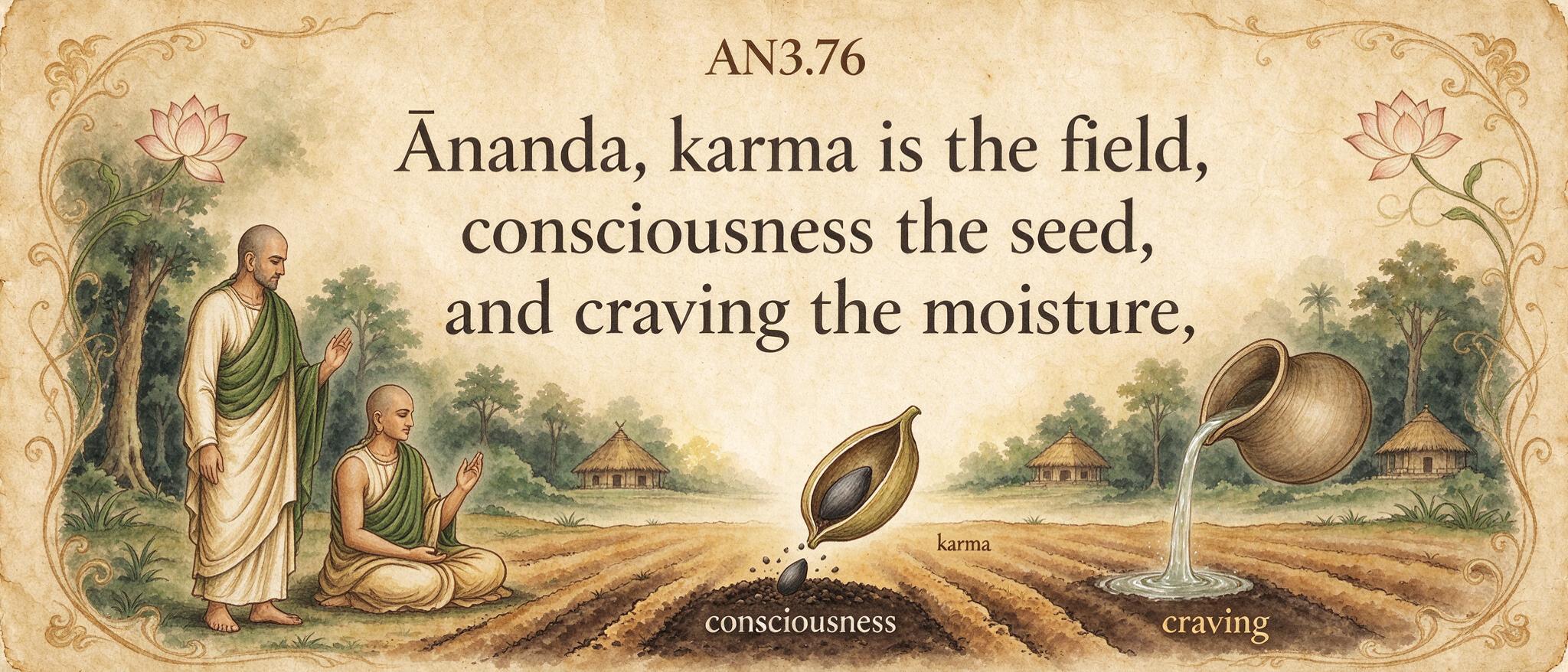
To better understand suffering, it is important to realize that stress and dissatisfaction, although felt in the present, are shaped by past causes and conditions, including past intentional actions, or kamma, and the habits they leave behind. When the right conditions come together, these shape our current experience.
The circumstances of this life, and the conditions carried from previous lives, shape the tendencies of mind we now carry: our likes and dislikes, our views, our moods, and the very ways we interpret the world. All these together shape what we experience in each moment.
These past conditions continue to influence us because they carry kammic momentum, the push left behind by former intentions. Each intentional action leaves a trace that can bear fruit when conditions allow. This ongoing stream of becoming is what the teachings call saṃsāra: the long wandering on, from one life to the next.
Suffering arises when we fail to understand this conditioning, when we try to control our actions, emotions, and outcomes as if they were entirely within our power, unaware that our very impulses are shaped by past kamma. Because of this blindness, we struggle against our own conditions, resisting what is already inevitable or forcing what is not yet possible. In doing so, we create new intentions rooted in delusion, and the wheel of dissatisfaction keeps turning.
This gives rise to an underlying feeling of helplessness, a constant strain to find lasting satisfaction and to control our experience. This is what saṃsāra feels like from the inside: at times we feel submerged and overwhelmed, at times content and peaceful, but most often we are craving something, trying to resist the constant change. We crave, we cling, and we live in fear of being pulled under or swept away into suffering.
Kamma and Samsāra
Kamma and saṃsāra are not separate things: intention is the action, craving and clinging keep it going, and the round of becoming is what it produces. Past intentional actions establish conditions that can influence future experience. When the appropriate conditions appear, habitual tendencies may become active; once craving and clinging take hold of them, those reactions become stress and suffering.
For example, if we have developed a liking for certain foods, or an aversion to particular behaviors, encountering them, through the senses or even in memory, can trigger a habitual reaction.
These reactions may manifest as unwholesome thoughts, speech, or actions. For more experienced disciples, the same process can be seen in subtler forms of clinging, aversion, or delusion: a faint tightening, a quiet wanting, or a slight resistance to what is.
Although past kamma and established tendencies condition our present experience, they do not have to determine our response. Our present intentions and reactions can reinforce habitual patterns or bring them to an end. It is not simply the arising of past kamma that perpetuates saṃsāra, but the continued feeding of craving and clinging through our present responses.
In other words, when we first begin to practice, we cannot prevent the results of past kamma from influencing our experience. Contact through the six senses brings pleasant, painful, and neutral feelings. But we can stop creating new unwholesome kamma by changing how we respond to that contact, instead of letting craving and aversion determine our intentions and actions.
It is important to understand that much of what we experience through the Five Aggregates is old kamma. Only our reaction to experience is new kamma. So, instead of clinging to the Five Aggregates: form, feeling, perception, mental formations, and consciousness, which are shaped by old kamma and cannot be controlled as we wish, we let any feelings, perceptions, or intentions that arise from old patterns pass away on their own. We do this by not attaching to them, not reacting to them, and not feeding them with new fuel. This is how the chain of craving is weakened, and we cease to plant new karmic seeds.
When we begin to see clearly that present experience is both shaped by the past and shaping the future, wisdom arises. We stop fighting what cannot be controlled and instead act with awareness and compassion. This is how we stop creating unwholesome kamma.
Beings are owners of their actions, heirs of their actions; they originate from their actions, are bound to their actions, and have their actions as their refuge. Actions distinguish beings as inferior and superior.
MN135
Kamma can also be understood at a simple level through the conditions it leaves behind: the likes and dislikes, intentions, habits, dreams, and memories we carry, many of them unfulfilled. These create restlessness or agitation of the mind, a burning energy that generates intentions to find satisfaction and happiness. So we are continually seeking something to alleviate this agitation, and the mind struggles to remain calm.
kamma should be understood, the source and origin of kamma should be understood, the diversity of kamma should be understood, the result of kamma should be understood, the cessation of kamma should be understood, and the way of practice leading to the cessation of kamma should be understood.
AN6.63
SN12.25: Sāriputta is asked by Venerable Bhūmija as to the origin of pleasure and pain. He replies that the Tathagata teaches that pleasure and pain originate by conditions. Moreover, all those who offer opinions on this question are themselves part of the web of conditions, as they cannot state their views without contact.
AN10.216: This Tathagata teaches that beings are the owners and heirs of their actions, determining their rebirth and future conditions based on their deeds. Actions, whether good or evil, lead to corresponding rebirths in realms of suffering or bliss. Misconduct by body, speech, and mind leads to rebirth in realms of intense suffering or as lower creatures like snakes and scorpions. Conversely, abstaining from harmful actions and cultivating compassion and righteousness leads to rebirth in blissful heavens or among noble families. Thus, one's destiny is shaped by one's actions.
To truly understand stress and suffering and to fully embrace the Eightfold Path, it’s essential to see how desire gives rise to intention. These intentions are kamma; they are the volitional push and pull that drive us.
Intentions shape our views, our thoughts, and our habits. And over time, they lead directly to the stress and dissatisfaction we experience in the present.
By understanding this process clearly, we begin to see why the Eightfold Path is the only way forward. It offers the means to cultivate new causes and conditions, ones that lead not to further stress, but to its cessation.
Desire: Why It Causes Stress and Dissatisfaction
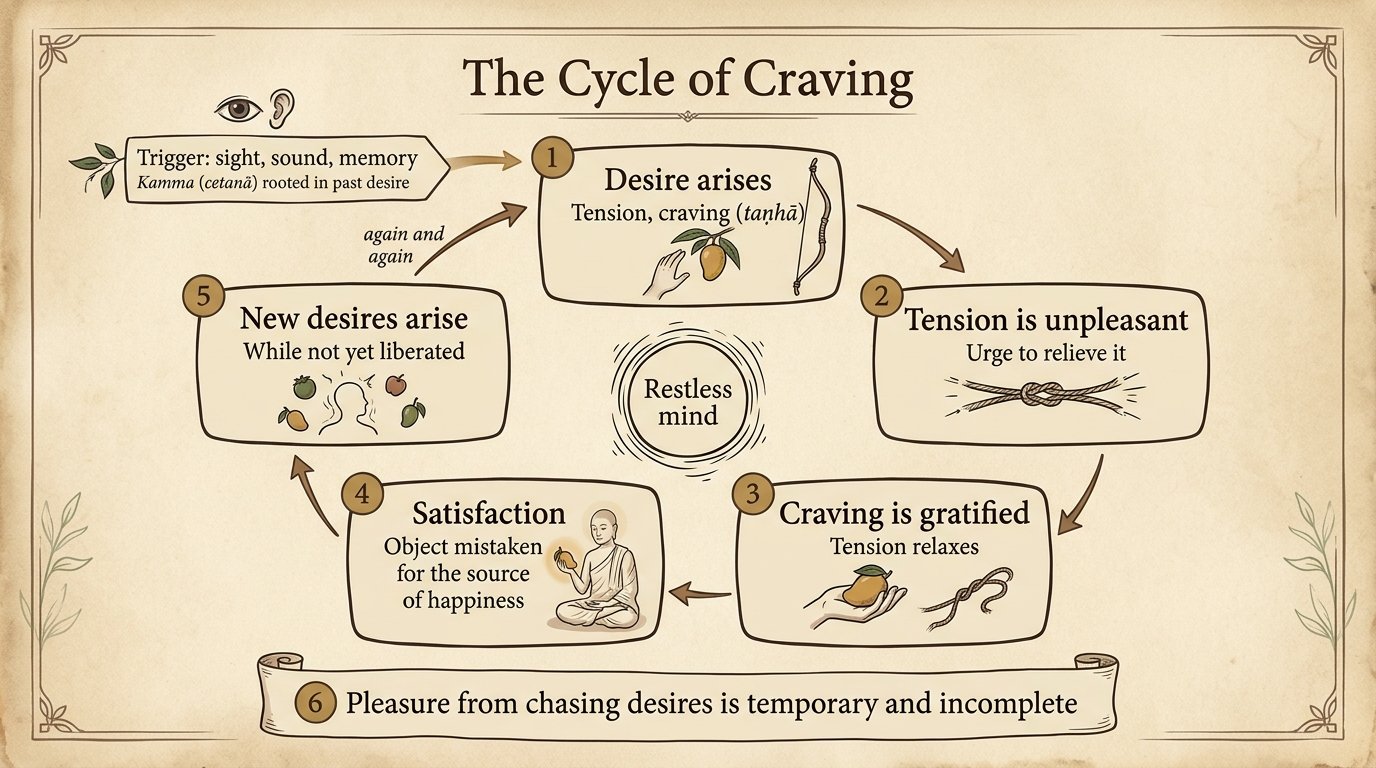
Because of the restlessness left by unfulfilled desires, the mind is always seeking something to cling to, something to relieve this agitation. Kamma, the intention, and the craving it leaves behind, is why something in our environment or in memory can trigger a desire, whether an old one renewed or a new desire altogether.
-
This desire causes tension or craving in the person experiencing it.
-
Since the tension is felt as unpleasant, the person is compelled to alleviate it by trying to satisfy the craving.
-
Obtaining the desired object and gratifying the craving relaxes the tension in the mind.
-
The relaxation of tension leads to a sense of satisfaction and fulfillment, accompanied by some degree of comfort. This creates the false belief that the desired object is the source of happiness.
-
As long as a person is not liberated, desires and cravings of all kinds will continue to arise, agitating the mind almost every moment.
-
Therefore, the relaxation of tension and resulting pleasure from chasing desires can never be anything more than temporary and incomplete.
For example, most people spend their whole lives chasing after things like money, material goods, beauty, status, delicious foods, winning competitions, affection, sex, or travel experiences. The expectations created, and the effort involved in trying to obtain these, cause tension and stress.
If we look carefully at this process, every time someone earns money, obtains a new possession, eats delicious food, wins a competition, obtains affection or sex, or goes on vacation, the stress from desires, cravings, expectations, and effort is temporarily relieved. This temporary relief is then mistaken as happiness obtained from that experience.
Because people believe happiness comes from making money, chasing beauty and status, receiving affection, winning competitions, or going on vacation, they repeat the cycle again and again, never achieving lasting satisfaction or happiness.
In reality, rather than recognizing that the letting go of desire and expectation and the relaxation of pressure from craving brought them satisfaction, people mistakenly believe the objects of desire themselves brought them happiness. In truth, desire is the cause of stress and dissatisfaction.
Since happiness does not come from craving or desire, which in fact causes pain, but from its ceasing, one should understand that the renunciation of craving and sense desires, far from causing misery, opens the only path to true and lasting happiness.
SN36.6: Both unlearned ordinary people and learned noble disciples experience pleasant, painful, and neutral feelings. The key difference lies in their reactions to these feelings. An ordinary person reacts to painful feelings with emotional distress and seeks relief in sensual pleasures, thus remaining attached to suffering due to ignorance of true escape. In contrast, a learned noble disciple does not react emotionally to pain, does not seek sensual pleasure, and understands the true nature of feelings, including their origin, danger, and escape, remaining detached from suffering. This understanding and detachment mark the profound difference between ordinary individuals and noble disciples in handling life experiences.
The Five Aggregates: Undependable, Unsatisfying, Not-self and Suffering

By & large, Kaccāna, this world is in bondage to attachments, clingings, & biases. But one such as this does not get involved with or cling to these attachments, clingings, fixations of awareness, biases, or obsessions; nor is he resolved on 'my self'.
He has no uncertainty or doubt that mere stress, when arising, is arising; stress, when passing away, is passing away. In this, his knowledge is independent of others. It’s to this extent, Kaccāna, that there is right view.
SN 12:15
The root of stress and dissatisfaction lies in the fundamental assumption that what we perceive through the Five Aggregates is reliable, substantial, and controllable, and that it represents reality as it actually is. We mistakenly equate the Five Aggregates with reality itself.
Instead of recognizing the insubstantial, impermanent, and not-self nature of experience, we take our perceptions — the dualities of good and bad, beautiful and ugly, fast and slow — to be the way things actually are. In fact they are shaped by our conditioning, our biases, and our fixations, not by any inherent essence in the objects. Clinging to these judgments strengthens the illusion of a “me” that possesses fixed likes and dislikes, a “me” that feels compelled to control shifting dualities, mistaking them for external realities instead of seeing them as products of the mind.
For example, once one attaches to and personally identifies with the perception of something as “good,” then, given changing causes and conditions, that “good” attribute is likely to shift toward “bad,” often oscillating back and forth with circumstances. This constant change causes stress and suffering.
The truth, therefore, lies not in believing or disbelieving these labels of good or bad, but in seeing them clearly without clinging to either. This is not indifference. The distinction between wholesome and unwholesome remains, and still has to be discerned; what is released is the grasping at the label, not the capacity to tell one from the other.
Everything exists: That is one extreme. Everything doesn’t exist: That is a second extreme. Avoiding these two extremes, the Tathāgata teaches the Dhamma via the middle.
SN 12.15
SN12.15: The venerable Kaccānagotta asked the Blessed One about the nature of right view. The Tathagata explained that the world largely operates on the duality of existence and nonexistence. He taught that true wisdom sees beyond these concepts, recognizing neither nonexistence nor existence of the world. The world is often trapped in attachment and identity, but right view involves understanding the impermanence of suffering without clinging to notions of self. The Tathagata emphasized avoiding the extremes of "everything exists" and "nothing exists," instead teaching the Middle Way, which links ignorance to the arising and cessation of suffering through dependent origination.
For example, perceptions, feelings, and thoughts arise and pass away on their own. They need not cause stress. But the mind clings to them, wanting them to exist or not to exist. This clinging is rooted in greed or aversion, and a sense of self is fabricated around that very wanting.
Stress arises because we cling to the arising of sensations and thoughts while ignoring their passing away and cessation. This attachment gives rise to unwholesome and deluded states of mind, and prevents these experiences from fading and ceasing on their own.
In simple terms, when one stops clinging to the judgments and details created by the Five Aggregates and lets these mental formations fade away on their own, the stress and unhappiness that came from that clinging come to an end.
The Fires of Craving

For him, infatuated, attached, confused, not remaining focused on their drawbacks, the five clinging-aggregates head toward future accumulation.
The craving that makes for further becoming, accompanied by passion & delight, relishing now here & now there, grows within him.
His bodily disturbances & mental disturbances grow. His bodily torments & mental torments grow. His bodily distresses & mental distresses grow. He is sensitive both to bodily stress & mental stress.
MN149
Another critical aspect of suffering is the cumulative nature of our desires and intentions. The Five Aggregates are like burning fires: the more desire and craving we feed into them, the stronger they blaze. As the Tathāgata describes:
"His bodily disturbances and mental disturbances grow. His bodily torments and mental torments grow. His bodily distresses and mental distresses grow. He is sensitive both to bodily stress and mental stress."
Each instance of desire and clinging is like adding fuel to a fire. Over time, these accumulated fires lead to heightened stress and various bodily and mental symptoms, which can manifest as physical tension, ailments, or other issues with no apparent cause.
In simple terms, every time desire, greed, aversion, and clinging arise, our overall stress level increases. When these “fires” become too intense or overwhelming, we “blow up,” releasing stress through anger, depression, indulgence in unwholesome foods or actions, or by storing it as tension in the body, often in some combination of these.
As a result, people develop unwholesome behaviors and bad habits as coping mechanisms to manage and release underlying stress and discomfort.
It is well recognized that stress is a primary cause of a wide range of mental and physical health problems. Therefore, clinging to the body, feelings, perceptions, intentions, and thoughts, the Five Aggregates, has profound and far-reaching consequences for long-term mental and physical well-being.
Close your eyes and experience the burning
Disciples, everything is burning. And what is everything that is burning? The eye is burning, forms are burning, eye-consciousness is burning, eye-contact is burning, and whatever feeling arises with eye-contact as condition: whether pleasant, painful, or neither-painful-nor-pleasant: that too is burning.
Burning with what? Burning with the fire of lust, with the fire of hatred, with the fire of delusion. Burning with birth, aging, and death, with sorrows, with lamentations, with pains, with distresses, with despairs, I say.
Suffering: In Future Lifetimes
So far, we have only addressed stress and suffering within this present lifetime. But the First Noble Truth is not limited to one life. The round of rebirth is unpredictable, and the teachings describe it as leading, often enough, to existences in unfavorable realms. If one could witness the suffering endured by beings across this and countless past lifetimes, it would become clear that even a human birth is not exempt from profound suffering.
To understand the nature of suffering, then, we must also take into account what lies ahead in countless future lives. This is not said to frighten. It matters because it changes what we take this life to be for. A human birth is described as rare and hard to obtain, and it is the condition in which the teaching can be heard and practised. Against the scale of the round, this life is a brief opening. The intentions we reinforce now, the craving we feed or let go, set the direction of what follows. Only by broadening our perspective in this way can we begin to grasp the full scope of the Tathāgata’s teachings.
What do you think, disciples? Which is greater, the tears you have shed while transmigrating & wandering this long, long time, crying & weeping from being joined with what is displeasing, being separated from what is pleasing, or the water in the four great oceans?
As we understand the Dhamma taught to us by the Blessed One, this is the greater: the tears we have shed while transmigrating & wandering this long, long time, crying & weeping from being joined with what is displeasing, being separated from what is pleasing, not the water in the four great oceans.
SN15.3)
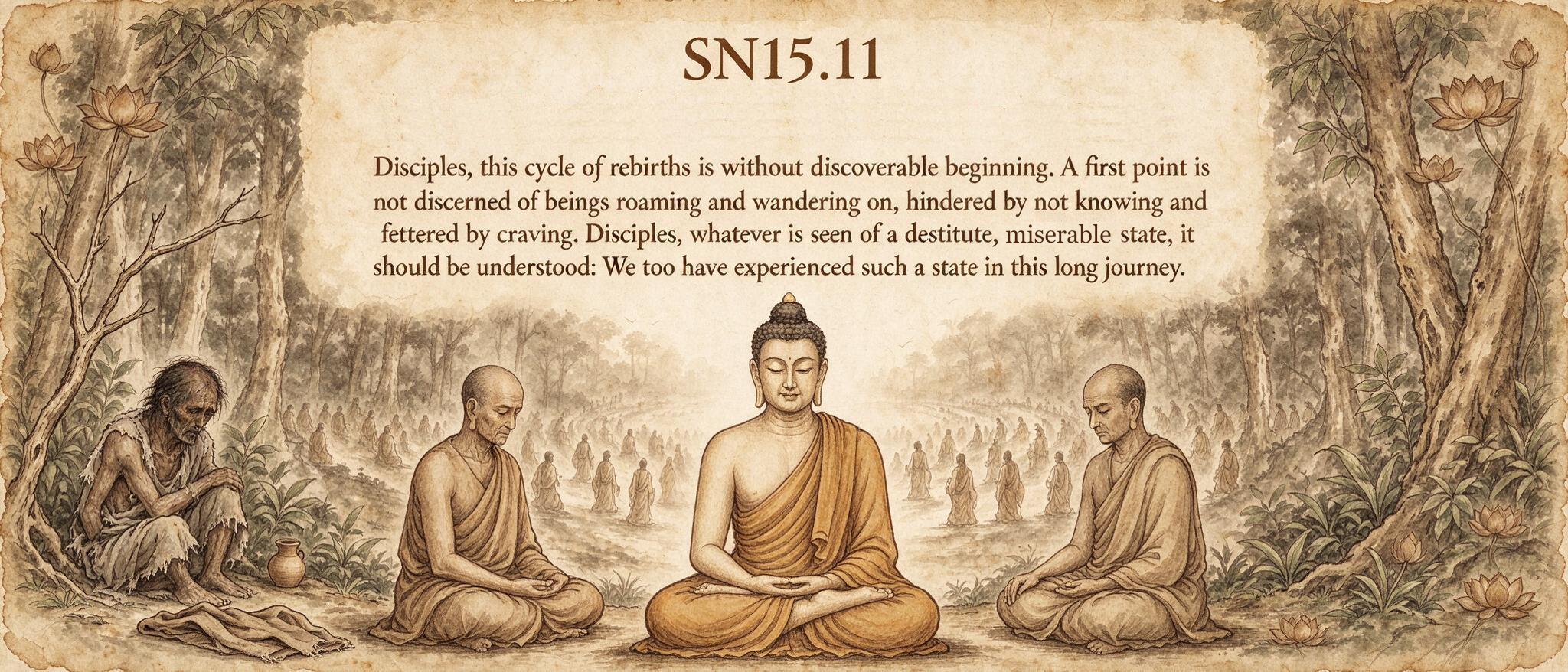
SN13.1: The Tathagata used a speck of dust on his fingernail to illustrate a point to the disciples. He compared the tiny amount of dust to the vastness of the earth, highlighting that the earth was immensely greater. Similarly, he explained that for a noble disciple who has attained right view and made a breakthrough in understanding the Dhamma, the suffering that remains is negligible compared to the vast amount of suffering that has been overcome. This demonstrates the profound benefit of realizing the Dhamma.
The Four Noble Truths
Having read or listened to the content so far, you should now have a good intellectual understanding of the First and Second Noble Truths.
First Noble Truth: And what is the noble truth of suffering? Birth is suffering, aging is suffering, death is suffering; sorrow, lamentation, pain, grief, and despair are suffering; association with the disliked is suffering, separation from the loved is suffering; not getting what one wants is suffering. In brief, the Five Aggregates subject to clinging are suffering.
Second Noble Truth: And what is the noble truth of the origin of suffering? It is this craving which leads to renewed existence, accompanied by delight and lust, seeking delight here and there; namely, craving for sensual pleasures, craving for existence, and craving for non-existence.
At this stage, it is important to remember that an intellectual understanding is only the beginning. The Four Noble Truths are not merely teachings to be understood, but the practical framework by which liberation unfolds.
Each truth has a specific task:
-
Suffering (dukkha) is to be known
-
Origin (samudaya) needs to be abandoned
-
Cessation (nirodha) needs to be realized
-
Path (magga) needs to be developed
Practice begins by investigating suffering itself. As we contemplate the Five Aggregates, we gradually see that body, feelings, perceptions, intentions, and consciousness are impermanent, unsatisfactory, and not-self. We begin to understand that suffering does not arise because these aggregates exist, but because they are appropriated as "I," "me," and "mine."
As this understanding deepens, craving gradually loses its foundation. The causes of suffering are no longer continually reinforced, and the conditions supporting suffering begin to fade. When craving is abandoned, its cessation naturally follows, and the Noble Eightfold Path progressively matures until ignorance is completely removed.
Third Noble Truth: And what is the noble truth of the cessation of suffering? It is the remainderless fading away and cessation of that same craving, the giving up and relinquishing of it, freedom from it, and non-reliance on it.
Fourth Noble Truth: And what is the noble truth of the path leading to the cessation of suffering? It is this Noble Eightfold Path, namely: Right View, Right Intention, Right Speech, Right Action, Right Livelihood, Right Effort, Right Mindfulness, and Right Concentration.
The Four Noble Truths are therefore much more than four doctrinal statements. They describe the progressive unfolding of the path itself. As wisdom develops, suffering is understood, its origin is abandoned, cessation is realized, and the Noble Eightfold Path reaches its complete fulfilment.
MN13: Challenged to show the difference between his teaching and that of other ascetics, the Tathagata points out that they speak of letting go, but do not really understand why. He then explains in great detail the suffering that arises from attachment to sensual stimulation.

Contemplation: Clinging to the Five Aggregates
A noble disciple understands clinging, its origin, its cessation, and the practice that leads to its cessation. But what is clinging? What is its origin, its cessation, and the practice that leads to its cessation?
There are these four kinds of clinging. Clinging at sensual pleasures, views, precepts and observances, and theories of a self. Clinging originates from craving. Clinging ceases when craving ceases. The practice that leads to the cessation of clinging is simply this noble eightfold path.
MN9
The discourses describe four ways people cling to the Five Aggregates, believing them to be the self.
First, there is clinging to the feelings and perceptions about the objects of the world, creating an identity around what is liked and what is disliked.
Second, as a result of this clinging, views arise about what is good and what is bad in the world. These views become entrenched, reinforcing the belief in a self, shaping ideas about how the world should and should not be, and how one ought to live.
Third, based on these views, habitual thoughts and routines take shape. They lead to further clinging, strengthening the sense of a self that is constantly seeking happiness and avoiding unhappiness in this world.
Fourth, the more likes and dislikes become ingrained as views, and the more these views are reinforced through habitual thoughts and actions, the deeper the clinging to the Five Aggregates becomes. One ignorantly believes that the body, feelings, perceptions, thoughts, and views are entirely real, substantial, and the self, and that they can be relied upon to avoid distress and secure happiness.
In other words, we identify with, take personally, and cling to what is experienced through the Five Aggregates, suffering because we ignore the truth: that what is experienced here is not absolute reality, but is conditioned by past causes, present conditions, and the distortions and imperfections of the world.
Contemplation: Clinging to Sensual Pleasures
All of us develop desires and preferences, our own ways of finding pleasure and happiness in the world. We believe this makes us individuals, separate from others. But when enjoying a favorite pleasure, pause and contemplate:
-
Is the enjoyment truly coming from the object or action itself? Or is it arising from the thoughts, feelings, and perceptions we hold about it?
-
When eating a delicious meal, is the deliciousness in the food itself or in our perceptions, feelings, expectations, and the stimulation of the taste buds?
-
Are the qualities we call beautiful, ugly, pleasurable, or distasteful really inherent in the object or action? Does everyone agree on what is beautiful or pleasurable?
-
Throughout the day, try recollecting your feelings and perceptions. Notice your likes and dislikes. Notice how perceptions are enhanced, diminished, or altered. Are they substantial? Reliable? Unchanging? Or do they shift and transform?
-
Look closely: are your feelings, perceptions, and thoughts touched by greed or aversion? This is why it is called clinging.
-
Ask yourself: are you clinging to the object itself or to the image and perception you have created about it in your own mind?
-
When you crave sensual pleasures, notice how you create in your imagination a little world: one where you are enjoying the pleasure, feeling happy or satisfied. Once this craving is made personal, expectations appear: “I like this. I want this.” This is craving.
-
See how craving carries the seeds of stress and dissatisfaction, whether from not being able to obtain the pleasure, from it not matching what was imagined, or from it disappearing altogether.
-
Contemplate what it feels like to live in that imagined world, chasing desires. Is the mind clear, or is it clouded with passion and longing? This is delusion.
-
Reflect on how greed or aversion toward sensual objects develops. Why do you like or dislike something? Is there truly something inherently bad or good in it? Or is that perception the result of clinging, and of building an identity filled with expectations?
Contemplation: Clinging to the Views We Hold About the World
As we develop likes and dislikes toward things in the world, these preferences often link together to form views about life. Over time, these views strengthen our attachment to the perception of a self.
It is common to hold strong opinions about how to live, about politics, and about almost every subject related to existence. We often believe these views define us, make us unique, and even determine our success in life. But consider this:
-
Is it truly possible to have “our own views”? Or were these views shaped by conditions and circumstances: by family, society, religion, language, peer influence, institutions, social media, advertising, and the events of our life?
-
What strong views do you hold about yourself? How did they come about? Are they really “you”? Did you accept them automatically, without deeply examining all possibilities and alternatives?
-
Many of us accept certain views without much thought. Some become so entrenched that we no longer see them as views at all; we take them as “truth.” These may be the hardest to question.
-
Reflect: What are views? How do they arise? And how does clinging to them create stress or suffering?
-
When faced with a problem in life, notice whether you have built a self-identity and a set of views around it. How does this cause stress or suffering when reality refuses to match your expectations?
-
Think about how a wrong view formed in youth can give rise to repeated unhappiness, stress, or suffering over the years.
-
When examining your views, ask yourself which will lead to long-term well-being and which will lead to long-term stress and unhappiness.
-
Are you blaming others when something goes wrong, instead of turning the lens inward to examine your own perspective? If you attribute blame to others or the world, are you actually causing harm to yourself, perhaps through anger or resentment?
-
Do you really need to hold on to a certain view? If you do, what is the benefit? Or will it limit your freedom and cause unhappiness?
-
Finally, consider that when you form views about entire categories, about people, politics, foods, behaviors, you are no longer seeing reality directly. You are only seeing the fabricated traits your mind has assigned.
Contemplation: Clinging to Habits and Routines
As strong views develop, they often take shape in our thoughts, habits, and routines, things we do automatically, often without much attention. We believe these patterns make us unique, defining how we think and act in our search for happiness. Eating, working, socializing, exercising, and pursuing hobbies all become part of this identity. Yet these habits and routines can further strengthen our clinging to the perception of a self.
Consider your thoughts, habits, and routines. Try to become aware of the motivations behind them.
-
What am I expecting from repeatedly thinking about something or performing the same routine over and over? Are my thoughts and actions simply mindless repetitions, causing stress without bringing any lasting satisfaction?
-
Reflect on your sense of self, the “me” who needs to get what I want, who must overcome obstacles. Notice how this sense of self shapes your actions and strengthens clinging.
-
Throughout the day, try to catch yourself in blind thought or automatic action. Ask, "Why am I thinking this, or why am I doing this?"
-
Consider whether some of your thoughts, habits, or routines are merely ways of avoiding unpleasant circumstances or feelings.
-
Finally, ask yourself: when things go wrong, do I blame others instead of examining my own thoughts and actions? Could this be a sign of delusion?
Contemplation: Clinging to the Aggregates Themselves
An uninstructed, run-of-the-mill person, assumes form to be the self, or the self as possessing form, or form as in the self, or the self as in form... He assumes feeling to be the self. He assumes perception to be the self. He assumes formations to be the self... He assumes consciousness to be the self, or the self as possessing consciousness, or consciousness as in the self, or the self as in consciousness.
SN 22.85
The deepest clinging is clinging to the Five Aggregates themselves as "self" or "belonging to self." This is the root of all other clinging.**
The discourses teach that the true source of clinging is the Five Aggregates themselves. We are deeply attached to our bodies, our feelings and perceptions, our thoughts, views, and consciousness. We take them to be part of us, who we are, and what we see as our self.
This clinging manifests as the assumption that "I am this body," "this body is mine," "I am these feelings," "these feelings are mine," and so on for perceptions, volitional formations, and consciousness.
Discerning clinging to the Five Aggregates will be explored later in the gradual training.

The Details of Pain
The following is a condensed version of the original article
Our dreams and delusions make us forget that we live in the midst of a mass of pain and stress, the stress of defilements, the pain of birth. Birth, aging, illness, and death: All of these are painful and stressful, in the midst of instability and change. They’re things we have no control over, for they must circle around in line with the laws of kamma and the defilements we’ve been amassing all along. Life that floats along in the round of rebirth is thus nothing but stress and pain.
If we can find a way to develop our mindfulness and discernment, they’ll be able to cut the round of rebirth so that we won’t have to keep wandering on. They’ll help us know that birth is painful, aging is painful, illness is painful, death is painful, and that these are all things that defilement, attachment, and craving keep driving through the cycles of change.
So as long as we have the opportunity, we should study the truths appearing throughout our body and mind, and we’ll come to know that the elimination of stress and pain, the elimination of defilement, is a function of our practice of the Dhamma. If we don’t practice the Dhamma, we’ll keep floating along in the round of rebirth that is so drearily repetitious, repetitious in its birth, aging, illness, and death, driven on by defilement, attachment, and craving, causing us repeated stress, repeated pain. Living beings for the most part don’t know where these stresses and pains come from or what they come from, because they’ve never studied them, never contemplated them, so they stay stupid and deluded, wandering on and on without end.…
If we can stop and be still, the mind will have a chance to be free, to contemplate its sufferings and to let them go. This will give it a measure of peace, because it will no longer want anything out of the round of rebirth, for it seems that there’s nothing lasting to it, that it’s simply stress over and over again. Whatever you grab hold of is stress. This is why you need mindfulness and discernment to know and see things for yourself, so that you can supervise the mind and keep it calm, without letting it fall victim to temptation.
This practice is something of the highest importance. People who don’t study or practice the Dhamma have wasted their birth as human beings, because they’re born deluded and simply stay deluded. But if we study the Dhamma, we’ll become wise to suffering and know the path of practice for freeing ourselves from it.…
Once we follow the right path, the defilements won’t be able to drag us around, won’t be able to burn us, because we’re the ones burning them away. We’ll come to realize that the more we can burn them away, the more strength of mind we’ll gain. If we let the defilements burn us, the mind will be sapped of its strength, which is why this is something you have to be very careful about. Keep trying to burn away the defilements in your every activity, and you’ll be storing up strength for your mindfulness and discernment so that they’ll be brave in dealing with all sorts of suffering and pain.
You must come to see the world as nothing but stress. There’s no real ease to it at all. The awareness we gain from mindfulness and discernment will make us disenchanted with life in the world because it will see things for what they are in every way, both within us and without.
The entire world is nothing but an affair of delusion, an affair of suffering. People who don’t know the Dhamma, don’t practice the Dhamma, no matter what their status or position in life, lead deluded, oblivious lives. When they fall ill or are about to die, they’re bound to suffer enormously because they haven’t taken the time to understand the defilements that burn their hearts and minds in everyday life. Yet if we make a constant practice of studying and contemplating ourselves as our everyday activity, it will help free us from all sorts of suffering and distress. And when this is the case, how can we not want to practice?
Only intelligent people, though, will be able to stick with the practice. Foolish people won’t want to bother. They’d much rather follow the defilements than burn them away. To practice the Dhamma you need a certain basic level of intelligence, enough to have seen at least something of the stresses and sufferings that come from defilement. Only then can your practice progress. And no matter how difficult it gets, you’ll have to keep practicing on to the end.
This practice isn’t something you do from time to time, you know. You have to keep at it continuously throughout life. Even if it involves so much physical pain or mental anguish that tears are bathing your cheeks, you have to keep with the chaste life because you’re playing for real. If you don’t follow the chaste life, you’ll get mired in heaps of suffering and flame. So you have to learn your lessons from pain. Try to contemplate it until you can understand it and let it go, and you’ll gain one of life’s greatest rewards.
Don’t think that you were born to gain this or that level of comfort. You were born to study pain and the causes of pain, and to follow the practice that frees you from pain. This is the most important thing there is. Everything else is trivial and unimportant. What’s important all lies with the practice.
Sutta Study
SN15.5: A disciple asked the Blessed One about the length of an eon. The Tathagata explained that an eon is immensely long, difficult to quantify in years. He used an analogy of a massive, solid mountain being worn away by a fine cloth stroked once every hundred years, stating that the mountain would erode faster than an eon would pass. He emphasized the vastness of time by mentioning the countless eons that have already passed, underscoring the endless cycle of rebirths. This led to the conclusion that one should aim to become disenchanted and liberated from all worldly formations.
SN22.1: The householder Nakulapitā asks the Tathagata for help in coping with old age. The Tathagata says to reflect: “Even though I am afflicted in body, my mind will be unafflicted.” Later Sāriputta explains this in terms of the five aggregates.
SN22.48: From Sāvatthi, the Khandhasutta teaches about the five aggregates and the five clinging aggregates. The five aggregates include form, feeling, perception, formations, and consciousness, encompassing all states whether past, present, or future, and varying in nature (internal/external, gross/subtle). The five clinging aggregates are similar but are characterized by being tainted and subject to clinging. This teaching highlights the nature of existence and attachment in philosophy.
SN22.95: The Blessed One, while at Ayujjhā on the Ganges riverbank, taught disciples about the nature of existence using various similes. He compared form, feeling, perception, formations, and consciousness to transient and insubstantial phenomena like foam, water bubbles, mirages, banana trees, and illusions. By observing and investigating these wisely, they appear empty and void of substance. This understanding leads a learned noble disciple to become disenchanted and dispassionate, ultimately achieving liberation. The Tathagata emphasized the importance of diligent investigation and mindfulness to see beyond the superficial and recognize the essenceless nature of all aggregates, urging disciples to seek liberation with the urgency of a head on fire.
SN56.48: In the Dutiyachiggaḷayuga Sutta, a metaphor is used where a blind turtle surfaces every hundred years, attempting to thread its neck through a yoke floating randomly on an ocean-covered earth. This illustrates the rarity of being born human, the arising of a Tathāgata (a Perfectly Enlightened One), and the presence of his Dhamma in the world. Given these rare opportunities, disciples are urged to diligently pursue understanding and cessation of suffering.